Basel Committee · Consultative document · November 2026

Interest rate risk in the banking book: additional Pillar 2 guidance

The Committee is proposing changes to SRP31 and a rewritten SRP98. Read it here a paragraph at a time, with the edits marked, and say what you think. No sign-in. No name, no email.

  • 213 paragraphs in the annex
  • 20 new, 11 amended
  • Comments to the Committee due 9 February 2027

Short on time? See only the 31 new or amended paragraphs.

About you (optional)

You'll appear as …

Tell us roughly where you sit and your reactions and comments can be grouped by bank type. Still anonymous. Remembered in this browser only.

1

Introduction

In April 2016, the Basel Committee published its standard on interest rate risk in the banking book (IRRBB).1 The IRRBB standard was subsequently incorporated into chapters SRP31 and SRP98 of the consolidated Basel Framework.2

In recent years, the Committee has conducted a series of analytical work to assess whether specific features of the Basel Framework continue to perform as intended. Through this analytical work, the Committee has noted shortcomings in banks’ fundamental risk management of certain basic banking risks, including management of IRRBB, which has faced challenges from heightened inflation and rate volatility. Thus, the Committee is proposing additional practical Pillar 2 guidance for banks and supervisors to improve the functionality of the IRRBB framework (SRP31 and SRP98). In developing the guidance, the Committee has considered the impacts of the global acceleration of inflation, ensuing sharp rise in interest rates and heightened interest rate volatility that posed challenges for many banks across jurisdictions.

The Committee welcomes comments from stakeholders on all aspects of the proposed additional Pillar 2 guidance for banks and supervisors. Comments should be submitted by 9 February 2027 using the following link: https://www.bis.org/publications/interest-rate-risk-banking-book---additional-pillar-2-guidance. All comments will be published on the website of the Bank for International Settlements unless a respondent specifically requests confidential treatment.

  1. 1 See https://www.bis.org/bcbs/publ/d368.pdf.
  2. 2 See https://www.bis.org/basel_framework.
2

Scope

Standalone guidelines to complement the current IRRBB framework

The Committee agreed on the need for standalone guidelines to complement the current IRRBB framework and replace the existing application guidance, SRP98. It also proposed incorporating the new SRP98 guidance into MIR20 of the consolidated guidelines.3 The guidelines are intended to improve risk management practices, strengthen supervisory oversight and streamline reporting processes, while preserving the flexibility needed to reflect the specific characteristics of individual banks. To ensure consistency across the broader IRRBB framework, certain foundational elements have also been incorporated into SRP31.

  1. 3 The Committee is proposing to migrate the contents of certain application guidance chapters in the Basel Framework to the consolidated guidelines. The content set out in SRP98, including the amendments proposed in this consultation document, would be incorporated into MIR20 as part of the consolidated guidelines. This proposal is intended to reduce the proliferation of guidance materials across the Committee’s website and to more clearly distinguish between standards and guidelines. For more information, see https://www.bis.org/publications/consolidated-guidelines-consequential-amendments.

Key areas of change

Additional guidance for banks

Model risk management and model governance

Sound risk management includes validation and ongoing performance monitoring of IRRBB models. This includes testing the robustness of models and modelling outputs, such as forecasts of non-maturity deposits (NMDs), prepayment speed for mortgages and pricing of deposits, through backtesting and/or other independent model validations, including early warning indicators. These measures aim to:

•
pre-emptively reveal model limitations; and
•
isolate the primary drivers of model underperformance on a regular cadence, and more frequently when warranted by market conditions, portfolio changes or past performance concerns, to ensure that models are functioning as intended.

Additional guidance is also provided on banks’ identification, validation and documentation of key assumptions that affect IRRBB measurement; modelling approaches, including banks’ implementation of appropriate time series to model IRRBB; and model validation processes pertaining to third-party vendor data. These measures aim to:

•
facilitate accurate implementation of IRRBB models to capture banks’ own risk profiles; and
•
validate assumptions tailored for the bank without overlooking responses to the changing environment or deviations from its practices.

Stress-testing approaches

Sound risk management includes stress testing that incorporates risk identification and controls, scenario development, scenario analysis and sensitivity testing at multiple levels of rate shocks, covering major balance sheet components. Additionally, sound risk management includes performing sensitivity analyses on key modelling assumptions for various stress scenarios. Based on their risk tolerance, banks establish risk controls to effectively monitor and manage their risks. Furthermore, it is good practice for banks to clearly communicate their stress-testing results and scenarios to bank senior management and report this information to supervisors. These measures aim to:

•
effectively test banks’ controls and measurements of IRRBB under stress, given their heterogeneous and complex nature;
•
pre-emptively reveal reliance on specific deposits segments; and
•
provide greater understanding of the non-linear impact of an interest rate change, including upward and downward shocks.

IRRBB control approaches

Supervisory information, as defined in Section 3.3 “Introduction of supervisory information”, includes the following dimensions of a bank’s risk control framework to allow supervisors to assess the effectiveness of banks’ IRRBB controls, as appropriate:

I.
A qualitative summary description of banks’ measures to control IRRBB, including limits and types of authorised hedging instruments approved to control IRRBB.
II.
An analysis of the impact of the adopted hedging instruments, on interest rate risk (IRR) metrics. When requested by the supervisor, an assessment of hedging effectiveness in addressing identified IRRBB risks may also be included.
III.
Delegated powers and lines of responsibility.
IV.
IRRBB exposures both with and without hedging based on the bank’s tools for controlling IRRBB.

Treatment of embedded losses

Supervisory information is introduced to holistically monitor the impact on capital and capture the risk profile associated with a bank’s investment securities portfolio. Supervisory information and reporting to bank senior management may include the bank’s current amount of embedded gains/losses; projections of embedded gains/losses under different rate shock scenarios; summary information about the extent of hedging provided to the securities portfolio; and results of internal stress tests under high levels of embedded losses, including the impact on the economic value of equity (EVE) and capital headroom. These measures aim to:

•
encourage banks with significant holdings of investment securities to assess the amount of embedded losses and gains associated with their securities portfolio held at amortised cost and to report the impact on capital headroom to bank senior management and supervisors, promoting holistic monitoring of the capital headroom; and
•
accurately capture risk profiles associated with banks’ own business models under business as usual and stress conditions.

Earnings indicators to assess IRRBB

Short- and medium-term earnings indicators are introduced to enhance risk management practices, which include firm-specific measurements of net interest income (NII) sensitivity such as 𝑁𝐼𝐼𝑠ℎ𝑜𝑐𝑘𝑒𝑇𝑑𝑖𝑒−𝑟𝑁1𝐼𝐼𝑏𝑎𝑠𝑒𝑙𝑖𝑛𝑒, 𝑎𝑙𝑖𝑠𝑒𝑑 and 3−𝑦𝑒𝑎𝑟 𝑎𝑣𝑒𝑟𝑎𝑔𝑒 𝑜𝑓∆𝑐𝑁𝑜𝐼𝑟𝐼𝑒 𝑜𝑝𝑒𝑟𝑎𝑡𝑖𝑛𝑔 𝑝𝑟𝑜𝑓𝑖𝑡. Banks are encouraged to address both NII and EVE in their risk management and controlling processes and take both into account when assessing risk capacity. These measures aim to promote:

Show the maths as printed
Line as printed, with the equationLine as printed, with the equation
•
the use of additional earnings indicators, as a supplement to current measurement and monitoring of IRR metrics to assess short- and medium-term risks to complement the Supervisory Outlier Test (Given the long-term nature of the balance sheet run-off horizon, the Supervisory Outlier Test alone might conceal short- and medium-term impacts of interest rate movements on earnings.);
•
a more holistic earnings impact analysis in response to changing rates, including related impacts on baseline NII, market value changes, repricing approaches and reverse stress testing; and
•
sound risk management practices, including identification of key assumptions affecting baseline NII and shocked NII such as curve flooring assumptions and loan prepayment optionality.
3.2

Additional guidance for supervisors

A peer comparison framework is introduced to enhance supervision of banks’ IRRBB management, leveraging supervisory information and enhanced supervisory approaches to identify reference groups based on selected dimensions (eg a static, operational or idiosyncratic dimension), as appropriate. This would enable supervisors to compare the bank’s supervisory information with that of its reference group, allowing for more in-depth supervisory monitoring as well as more effective examinations, leading to:

•
earlier identification of banks with potentially excessive IRRBB risk, supporting supervisory assessment for phased action;
•
more effective supervision of banks’ IRRBB management through trend analysis or supervisory tools (eg supervisory backtesting on NMD models) utilising banks’ supervisory information; and
•
more effective, clear communication between banks and supervisors.
3.3

Introduction of supervisory information

Supervisory information comprises information that banks report to supervisors as part of ongoing monitoring or examinations related to IRRBB. This information may include, inter alia, information on modelling practices, hedging, earnings indicators and embedded losses. The guidelines provide a table with examples of the types of supervisory information that banks may report to supervisors. Supervisory information enhances the functionality of the IRRBB framework for banks and supervisors by:

•
closing supervisory data gaps and improving the quality of banks’ IRRBB data;
•
enhancing supervisors’ understanding of the basis of banks’ senior management’s decision-making;
•
facilitating overall improvements in bank governance by addressing any potential lack of transparency in internal reporting, strengthening the independent validation process, including with an appropriate second line of defence, and ensuring senior management involvement; and
•
serving as a common basis for supervisory review, promoting a reduction in excessive IRRBB by increasing accountability of both banks and supervisors through greater transparency in banks’ IRRBB management.

Annex: Proposed edits to SRP31 and SRP98

SRP31 edits

Chapter details
Standard acronymSRP
Standard nameSupervisory review process
Description of standardThe Pillar 2 supervisory review process ensures that banks have adequate capital and liquidity to support all the risks in their business, especially with respect to risks not fully captured by the Pillar 1 process, and encourages good risk management.
Chapter acronymSRP31
Chapter nameInterest rate risk in the banking book
Description of chapterThis chapter describes requirements on assessing interest rate risk in the banking book, ie the current or prospective risk to a bank’s capital and to its earnings, arising from the impact of adverse movements in interest rates on its banking book. Due to the heterogeneous nature of this risk, it is captured in Pillar 2.
Version effective from01.01.2026
Change descriptionUpdated to take account of the recalibration of shocks in the interest rate risk in the banking book standard and the targeted adjustments to the current methodology used to calculate the shocks published on 16 July 2024.

Definition of IRRBB

Interest rate risk in the banking book (IRRBB) refers to the current or prospective risk to the bank’s capital and earnings arising from adverse movements in interest rates that affect the bank’s banking book positions. When interest rates change, the present value and timing of future cash flows change. This in turn changes the underlying value of a bank’s assets, liabilities and off-balance sheet items and hence its economic value. Changes in interest rates also affect a bank’s earnings by altering interest rate-sensitive income and expenses, affecting its net interest income (NII). Excessive IRRBB can pose a significant threat to a bank’s current capital base and/or future earnings if not managed appropriately. A more detailed description of IRRBB and its management techniques can be found in [SRP98].

Three main sub-types of IRRBB are defined for the purposes of this chapter. All three sub-types of IRRBB potentially change the price/value or earnings/costs of interest rate-sensitive assets, liabilities and/or off-balance sheet items in a way, or at a time, that can adversely affect a bank’s financial condition.

(1)
Gap risk arises from the term structure of banking book instruments, and describes the risk arising from the timing of instruments’ rate changes. The extent of gap risk depends on whether changes to the term structure of interest rates occur consistently across the yield curve (parallel risk) or differentially by period (non-parallel risk).
(2)
Basis risk describes the impact of relative changes in interest rates for financial instruments that have similar tenors but are priced using different interest rate indices.
(3)
Option risk arises from option derivative positions or from optional elements embedded in a bank’s assets, liabilities and/or off-balance sheet items, where the bank or its customer can alter the level and timing of their cash flows. Option risk can be further characterised into automatic option risk and behavioural option risk.

While the three sub-types listed above are directly linked to IRRBB, credit spread risk in the banking book (CSRBB) is a related risk that banks need to monitor and assess in their interest rate risk management framework. CSRBB refers to any kind of asset/liability spread risk of credit-risky instruments that is not explained by IRRBB and by the expected credit/jump to default risk.

Principles for banks and supervisors on interest rate risk

The following principles define supervisory expectations on the management of IRRBB. Principles 1 to 7 are of general application for the management of IRRBB, covering expectations for a bank’s IRRBB management process, in particular the need for effective IRRBB identification, measurement, monitoring and control activities. Principles 8 and 9 set out the expectations for market disclosures and banks’ internal assessment of capital adequacy for IRRBB respectively. Principles 10 to 12 address the supervisory approach to banks’ IRRBB management framework and capital adequacy.

(1)
IRRBB is an important risk for all banks that must be specifically identified, measured, monitored and controlled. In addition, banks should monitor and assess CSRBB.
(2)
The governing body of each bank is responsible for oversight of the IRRBB management framework, and the bank’s risk appetite for IRRBB. Monitoring and management of IRRBB may be delegated by the governing body to senior management, expert individuals or an asset and liability management committee (henceforth, its delegates). Banks must have an adequate IRRBB management framework, involving regular independent reviews and evaluations of the effectiveness of the system.
(3)
The banks’ risk appetite for IRRBB should be articulated in terms of the risk to both economic value and earnings. Banks must implement policy limits that target maintaining IRRBB exposures consistent with their risk appetite.
(4)
Measurement of IRRBB should be based on outcomes of both economic value and earnings-based measures, arising from a wide and appropriate range of interest rate shock and stress scenarios.
(5)
In measuring IRRBB, key behavioural and modelling assumptions should be fully understood, conceptually sound and documented. Such assumptions should be rigorously tested and aligned with the bank’s business strategies.
(6)
Measurement systems and models used for IRRBB should be based on accurate data, and subject to appropriate documentation, testing and controls to give assurance on the accuracy of calculations. Models used to measure IRRBB should be comprehensive and covered by governance processes for model risk management, including a validation function that is independent of the development process.
(7)
Measurement outcomes of IRRBB and hedging strategies should be reported to the governing body or its delegates on a regular basis, at relevant levels of aggregation (by consolidation level and currency).
(8)
Information on the level of IRRBB exposure and practices for measuring and controlling IRRBB must be disclosed to the public on a regular basis.
(9)
Capital adequacy for IRRBB must be specifically considered as part of the Internal Capital Adequacy Assessment Process (ICAAP) approved by the governing body, in line with the bank’s risk appetite on IRRBB.
(10)
Supervisors should, on a regular basis, collect sufficient information from banks to be able to monitor trends in banks’ IRRBB exposures, assess the soundness of banks’ IRRBB management and identify outlier banks that should be subject to review and/or should be expected to hold additional regulatory capital.
(11)
Supervisors should regularly assess banks’ IRRBB and the effectiveness of the approaches that banks use to identify, measure, monitor and control IRRBB. Supervisory authorities should employ specialist resources to assist with such assessments. Supervisors should cooperate and share information with relevant supervisors in other jurisdictions regarding the supervision of banks’ IRRBB exposures.
(12)
Supervisors must publish their criteria for identifying outlier banks. Banks identified as outliers must be considered as potentially having undue IRRBB. When a review of a bank’s IRRBB exposure reveals inadequate management or excessive risk relative to capital, earnings or general risk profile, supervisors must require mitigation actions and/or additional capital.


The implementation of these principles should be commensurate with the bank’s nature, size and complexity as well as its structure, economic significance and general risk profile. This requires that supervisors gauge their responses where appropriate for banks with low IRRBB profiles. In particular, supervisors will focus on systemic risks that are inherent in large, complex or internationally active banks.

Principle 1 – identification and monitoring of IRRBB

IRRBB is an important risk that arises from banking activities, and is encountered by all banks. It arises because interest rates can vary significantly over time, while the business of banking typically involves intermediation activity that produces exposures to both maturity mismatch (eg long-maturity assets funded by short-maturity liabilities) and rate mismatch (eg fixed rate loans funded by variable rate deposits). In addition, there are optionalities embedded in many of the common banking products (eg non-maturity deposits, term deposits, fixed rate loans) that are triggered in accordance with changes in interest rates.

All banks must be familiar with all elements of IRRBB, actively identify their IRRBB exposures and take appropriate steps to measure, monitor and control it.

Banks must identify the IRRBB inherent in products and activities, and ensure that these are subject to adequate procedures and controls. Significant hedging or risk management initiatives must be approved before being implemented. Products and activities that are new to a bank must undergo a careful preacquisition review to ensure that the IRRBB characteristics are well understood and subject to a predetermined test phase before being fully rolled out. Prior to introducing a new product, hedging or risk-taking strategy, adequate operational procedures and risk control systems must be in place. The management of a bank’s IRRBB should be integrated within its broader risk management framework and aligned with its business planning and budgeting activities.

In identifying, measuring, monitoring and controlling IRRBB, banks should also ensure that CSRBB is properly monitored and assessed.

Principle 2 – IRRBB management framework

The governing body1 has responsibility for understanding the nature and the level of the bank’s IRRBB exposure. The governing body should approve broad business strategies as well as overall policies with respect to IRRBB. It should ensure that there is clear guidance regarding the acceptable level of IRRBB, given the bank’s business strategies.

  1. 1 This refers to the body that supervises management. The structure of bank boards differs among countries. See the Corporate Governance Principles for Banks published by the Committee in July 2015.

Accordingly, the governing body is responsible for ensuring that steps are taken by the bank to identify, measure, monitor and control IRRBB consistent with the approved strategies and policies. More specifically, the governing body or its delegates are responsible for setting:

(1)
appropriate limits on IRRBB, including the definition of specific procedures and approvals necessary for exceptions, and ensuring compliance with those limits;
(2)
adequate systems and standards for measuring IRRBB;
(3)
standards for measuring IRRBB, valuing positions and assessing performance, including procedures for updating interest rate shock and stress scenarios and key underlying assumptions driving the institution’s IRRBB analysis;
(4)
a comprehensive IRRBB reporting and review process; and
(5)
effective internal controls and management information systems (MIS).

The governing body or its delegates should oversee the approval, implementation and review of IRRBB management policies, procedures and limits. The governing body should be informed regularly (at least semiannually) on the level and trend of the bank’s IRRBB exposures. It should regularly review timely information that is sufficiently detailed to allow it to understand and assess the performance of its delegates in monitoring and controlling IRRBB in compliance with policies approved by the governing body. Such reviews should be carried out more frequently when the bank runs significant IRRBB exposures or has positions in complex IRRBB instruments.

While governing body members do not need individually to have detailed technical knowledge of complex financial instruments, or of quantitative risk management techniques, they should understand the implications of the bank’s IRRBB strategies, including the potential linkages with and impact on market, liquidity, credit and operational risk. Some of the members should have sufficient technical knowledge to question and challenge the reports made to the governing body. Governing body members are responsible for ensuring that senior management has the capability and skills to understand IRRBB, and that adequate resources are devoted to IRRBB management.

Many governing bodies delegate the task for developing IRRBB policies and practices to senior management, expert individuals or an asset and liability management committee (ALCO). In the case of an ALCO, it should meet regularly and include representatives from each major department connected to IRRBB.

The governing body should clearly identify its delegates for managing IRRBB and, to avoid potential conflicts of interest, should ensure that there is adequate separation of responsibilities in key elements of the risk management process. Banks should have IRRBB identification, measurement, monitoring and control functions with clearly defined responsibilities that are sufficiently independent from risk-taking functions of the bank and that report IRRBB exposures directly to the governing body or its delegates.

The governing body’s delegates for IRRBB should include members with clear lines of authority over the units responsible for establishing and managing positions. There should be a clear communication channel to convey the delegates’ directives to these line units.

The governing body should ensure that the bank’s organisational structure enables its delegates to carry out their responsibilities, and facilitates effective decision-making and good governance. The governing body should encourage discussions between its members and its delegates – as well as between its delegates and others in the bank – regarding the IRRBB management process. The risk management and strategic planning areas of the bank should also communicate regularly to facilitate evaluations of risk arising from future business.

Banks should have adequate internal controls to ensure the integrity of their IRRBB management process. The internal controls should promote effective and efficient operations, reliable financial and regulatory reporting, and compliance with relevant laws, regulations and bank policies.

With regard to IRRBB control policies and procedures, banks should have appropriate approval processes, exposure limits, reviews and other mechanisms designed to provide a reasonable assurance that risk management objectives are being achieved.

In addition, banks should have in place regular evaluations and reviews of their internal control system and risk management processes. This includes ensuring that personnel comply with established policies and procedures. Such reviews should also address any significant changes that may affect the effectiveness of controls (including changes in market conditions, personnel, technology and structures of compliance with exposure limits), and ensure that there are appropriate escalation procedures for any exceeded limits. Banks should ensure that all such evaluations and reviews are conducted regularly by individuals and/or units that are independent of the function they are assigned to review. When revisions or enhancements to internal controls are warranted, there should be an internal review mechanism in place to ensure that these are implemented in a timely manner.

Banks should have their IRRBB identification, measurement, monitoring and control processes reviewed by an independent auditing function (such as an internal or external auditor) on a regular basis. In such cases, reports written by internal/external auditors or other equivalent external parties (such as consultants) should be made available to relevant supervisory authorities.

Principle 3 – IRRBB risk appetite

Banks should have clearly defined risk appetite statements2 that are approved by the governing body and implemented through comprehensive risk appetite frameworks, ie policies and procedures for limiting and controlling IRRBB. The risk appetite framework should delineate delegated powers, lines of responsibility and accountability over IRRBB management decisions and should clearly define authorised instruments, hedging strategies and risk-taking opportunities. All IRRBB policies should be reviewed periodically (at least annually) and revised as needed.

  1. 2 A risk appetite statement is a written articulation of the aggregated level and types of IRRBB exposures that a bank will accept, or avoid, in order to achieve its business objectives.

Policy limits set by the governing bodies should be consistent with the bank’s overall approach for measuring IRRBB. Aggregate risk limits, clearly articulating the amount of IRRBB acceptable to the governing body, should be applied on a consolidated basis and, as appropriate, at the level of individual affiliates. Limits may be associated with specific scenarios of changes in interest rates and/or term structures, such as an increase or decrease of a particular size or a change in shape. The interest rate movements used in developing these limits should represent meaningful shock and stress situations, taking into account historical interest rate volatility and the time required by management to mitigate those risk exposures.

Policy limits should be appropriate to the nature, size, complexity and capital adequacy of the bank, as well as its ability to measure and manage its risks. Depending on the nature of a bank's activities and business model, sub-limits may also be identified for individual business units, portfolios, instrument types or specific instruments. The level of detail of risk limits should reflect the characteristics of the bank’s holdings, including the various sources of the bank’s IRRBB exposures. Banks with significant exposures to gap risk, basis risk or positions with explicit or embedded options should establish risk tolerances appropriate for these risks.

The governing body or its delegates should approve major hedging or risk-taking initiatives in advance of implementation.3 A dedicated set of risk limits should be developed to monitor the evolution of hedging strategies that rely on instruments such as derivatives, and to control mark-to-market risks in instruments that are accounted for at market value. Proposals to use new instrument types or new strategies (including hedging) should be assessed to ensure that the resources required to establish sound and effective IRRBB management of the product or activity have been identified, that the proposed activities are in line with the bank’s overall risk appetite, and procedures to identify, measure, monitor and control the risks of the proposed product or activity have been established.

  1. 3 Positions related to internal risk transfers between the banking book and the trading book should be properly documented.

There should be systems in place to ensure that positions that exceed, or are likely to exceed, limits defined by the governing body or its delegates should receive prompt management attention and be escalated without delay. There should be a clear policy on who will be informed, how the communication will take place and the actions which will be taken in response to an exception.4

  1. 4 Limits could be absolute in the sense that they should never be exceeded or of whether, under specific circumstances, breaches of limits can be tolerated for a predetermined short period of time.

Principle 4 – IRRBB measurement

Banks’ internal measurement systems (IMS) should capture all material sources of IRRBB and assess the effect of market changes on the scope of their activities. In addition to the impact of an interest rate shock on its economic value, a bank’s policy approach should take into account its ability to generate stable earnings sufficient to maintain its normal business operations.

Banks should pay attention to the complementary nature of economic value and earnings-based measures in their risk and internal capital assessments, in particular in terms of:

(1)
outcomes: economic value measures compute a change in the net present value of the bank’s assets, liabilities and off-balance sheet items subject to specific interest rate shock and stress scenarios, while earnings-based measures focus on changes to future profitability within a given time horizon eventually affecting future levels of a bank’s own equity capital;
(2)
assessment horizons: economic value measures reflect changes in value over the remaining life of the bank’s assets, liabilities and off-balance sheet items, ie until all positions have run off, while earnings-based measures cover only the short to medium term, and therefore do not fully capture those risks that will continue to impact profit and loss accounts beyond the period of estimation; and
(3)
future business/production: economic value measures consider the net present value of repricing cash flows of instruments on the bank’s balance sheet or accounted for as an off-balance sheet item (ie a run-off view). Earnings measures may, in addition to a run-off view, assume rollover of maturing items (ie a constant balance sheet view) and/or assess the scenario-consistent impact on the bank’s future earnings inclusive of future business (ie a dynamic view).5
  1. 5 A dynamic view can be useful for business planning and budgeting purposes. However, dynamic approaches are dependent on key variables and assumptions that are extremely difficult to project with accuracy over an extended period and can potentially hide certain key underlying risk exposures.
31.29 Amended

While the economic value and earnings-based measures share certain commonalities, the Committee observes that most commercial banks primarily utilise the latter for IRRBB management, whereas regulators tend to endorse the former as a benchmark for comparability and capital adequacy. The Committee acknowledges the importance of managing IRRBB through both economic value and earnings-based measures. If a bank solely minimises its economic value risk by matching the repricing of its assets with liabilities beyond the short term, it could run the risk of earnings volatility. To complement economic value measurement and monitoring of interest rate risk metrics, sound risk management includes the use of short- and medium-term earnings indicators and holistic earnings impact analysis in response to changing rates.

Banks’ IMS for IRRBB should be able to accommodate the calculation of the impact on economic value and earnings of multiple scenarios, based on:

(1)
internally selected interest rate shock scenarios addressing the bank’s risk profile, according to its ICAAP;
(2)
historical and hypothetical interest rate stress scenarios, which tend to be more severe than shock scenarios;
(3)
the six prescribed interest rate shock scenarios set out in [SRP31.94] to [SRP31.97]; and
(4)
any additional interest rate shock scenarios required by supervisors.

Banks should measure their vulnerability to loss under stressful market conditions – including the breakdown of key assumptions – and consider those results when establishing and reviewing their policies and limits for IRRBB.

A bank should develop and implement an effective stress testing framework for IRRBB as part of its broader risk management and governance processes. This should feed into the decision-making process at the appropriate management level, including strategic decisions (eg business and capital planning decisions) of the governing body or its delegates. In particular, IRRBB stress testing should be considered in the ICAAP, requiring banks to undertake rigorous, forward-looking stress testing that identifies events of severe changes in market conditions which could adversely impact the bank’s capital or earnings, possibly also through changes in the behaviour of its customer base.

31.33 Amended

A bank’s stress testing framework for IRRBB should be commensurate with its nature, size and complexity as well as business activities and overall risk profile. The framework should include clearly defined objectives, scenarios tailored to the bank’s businesses and risks, well documented assumptions and sound methodologies. Sound risk management includes the identification of risk scenarios that could significantly impact a bank’s IRRBB. The framework will be used to assess the potential impact of the scenarios on the bank’s financial condition, enable ongoing and effective review processes for stress tests and recommend actions based on the stress test results. IRRBB stress tests should play an important role in the communication of risks, both within the bank and externally with supervisors and the market through appropriate disclosures.

The identification of relevant shock and stress scenarios for IRRBB, the application of sound modelling approaches and the appropriate use of the stress testing results require the collaboration of different experts within a bank (eg traders, the treasury department, the finance department, the ALCO, the risk management and risk control departments and/or the bank’s economists). A stress-testing programme for IRRBB should ensure that the opinions of the experts are taken into account.

31.35 Amended

Banks should determine, by currency, a range of potential interest rate movements against which they will measure their IRRBB exposures. Management should ensure that risk is measured under a reasonable range of potential interest rate scenarios, including some containing severe stress elements. In developing the scenarios, banks should consider a variety of factors, such as the shape and level of the current term structure of interest rates and the historical and implied volatility of interest rates. In low interest rate environments, banks should also consider negative interest rate scenarios and the possibility of asymmetrical effects of negative interest rates on their assets and liabilities.

31.36 Amended

A bank should consider the nature and sources of its IRRBB exposures, the time it would need to take action to reduce or unwind unfavourable IRRBB exposures, and its capability/willingness to withstand accounting losses in order to reposition its risk profile. A bank should select scenarios that provide meaningful estimates of risk and include a range of shocks that is sufficiently wide to allow the governing body or its delegates to understand the risk inherent in the bank’s products and activities. When developing interest rate shock and stress scenarios for IRRBB, banks should consider the following:

(1)
The scenarios should be sufficiently wide-ranging to identify parallel and non-parallel gap risk, basis risk and option risk. In many cases, static interest rate shocks may be insufficient to assess IRRBB exposure adequately. Banks should ensure that the scenarios are both severe and plausible, in light of the existing level of interest rates and the interest rate cycle.
(2)
Special consideration should be given to instruments or markets where concentrations exist, because those positions may be more difficult to liquidate or offset in a stressful market environment.
(3)
Banks should assess the possible interaction of IRRBB with its related risks, as well as other risks (eg credit risk, liquidity risk).
(4)
Banks should assess the effect of adverse changes in the spreads of new assets/liabilities replacing those assets/liabilities maturing over the horizon of the forecast on their NII.
(5)
Banks with significant option risk should include scenarios that capture the exercise of such options. For example, banks that have products with sold caps or floors should include scenarios that assess how the risk positions would change should those caps or floors move into the money. Given that the market value of options also fluctuates with changes in the volatility of interest rates, banks should develop interest rate assumptions to measure their IRRBB exposures to changes in interest rate volatilities.
(6)
Banks should specify, in building their interest rate shock and stress scenarios, the term structure of interest rates that will be incorporated and the basis relationship between yield curves, rate indices etc as well as applying sound risk management to consider different possible levels and scenarios when conducting sensitivity testing. Banks should also estimate how interest rates that are administered or managed by management (eg prime rates or retail deposit rates, as opposed to those that are purely market-driven) might change. Management should document how these assumptions are derived.
(7)
In addition, forward-looking scenarios should incorporate changes in portfolio composition due to factors under the control of the bank (eg the bank’s acquisition and production plans) as well as external factors (eg changing competitive, legal or tax environments); new products where only limited historical data are available; new market information and new emerging risks that are not necessarily covered by historical stress episodes.

Further, banks should perform qualitative and quantitative reverse stress tests6 in order to:

(1)
identify interest rate scenarios that could severely threaten a bank’s capital and earnings; and
(2)
reveal vulnerabilities arising from its hedging strategies and the potential behavioural reactions of its customers.
  1. 6 See the Principles of sound stress testing practices and supervision published by the Committee in October 2018.
31.38 New

Sound risk management includes conducting stress tests on a regular basis and more frequently when warranted by market conditions, changes in the portfolio or increased interest rate risk exposure levels.

31.39 New

Changes in interest rates may impact the market value of a bank’s portfolio, including its embedded gains and losses.7 Sound risk management includes holistically monitoring the impact on capital headroom and capturing the risk profile associated with a bank’s portfolio, particularly for the securities held at amortised cost.

  1. 7 Embedded gains and losses refer to the difference between book value and market value of all instruments in the banking book.

Principle 5 – behavioural and modelling assumptions

Both economic value and earnings-based measures of IRRBB are significantly impacted by a number of assumptions made for the purposes of risk quantification, namely:

(1)
expectations for the exercise of interest rate options (explicit and embedded) by both the bank and its customers under specific interest rate shock and stress scenarios;
(2)
treatment of balances and interest flows arising from non-maturity deposits (NMDs);
(3)
treatment of own equity in economic value measures; and
(4)
the implications of accounting practices for IRRBB.

Hence, when assessing its IRRBB exposures, a bank should make judgments and assumptions about how an instrument’s actual maturity or repricing behaviour may vary from the instrument’s contractual terms because of behavioural optionalities.

Common products with behavioural optionalities include:

(1)
Fixed rate loans subject to prepayment risk – Banks should understand the nature of prepayment risk for their portfolios and make reasonable and prudent estimates of the expected prepayments. The assumptions underlying the estimates and where prepayment penalties or other contractual features affect the embedded optionality effect should be documented. There are several factors that are important determinants of the bank’s estimate of the effect of each interest rate shock and stress scenario on the average prepayment speed. Specifically, a bank must assess the expected average prepayment speed under each scenario.
(2)
Fixed rate loan commitments – Banks may sell options to retail customers (eg prospective mortgage buyers or renewers) whereby, for a limited period, the customers can choose to draw down a loan at a committed rate. Unlike loan commitments to corporates, where drawdowns strongly reflect characteristics of automatic interest rate options, mortgage commitments (ie pipelines) to retail customers are impacted by other drivers.
(3)
Term deposits subject to early redemption risk – Banks may attract deposits with a contractual maturity term or with step-up clauses that enable the depositor at different time periods to modify the speed of redemption. The classification scheme should be documented, whether a term deposit is deemed to be subject to redemption penalties or to other contractual features that preserve the cash flow profile of the instrument.
(4)
NMDs – Behavioural assumptions for deposits that have no specific repricing date can be a major determinant of IRRBB exposures under the economic value and earnings-based measures. Banks should document, monitor and regularly update key assumptions for NMD balances and behaviour used in their IMS. To determine the appropriate assumptions for its NMDs, a bank should analyse its depositor base in order to identify the proportion of core deposits (ie NMDs which are unlikely to reprice even under significant changes in interest rate environment). Assumptions should vary according to depositor characteristics (eg retail/wholesale) and account characteristics (eg transactional/non-transactional).
31.43 Amended

Modelling assumptions should be conceptually sound and reasonable, and consistent with historical experience. Banks must carefully consider how the exercise of the behavioural optionality will vary not only under the interest rate shock and stress scenario but also across other dimensions, such as different markets, jurisdictions and products, and apply a prudent segmentation in modelling. Examples of modelling considerations related to data inputs and components are set out in Table 1. For instance, considerations may include those set out in Table 1.

Considerations affecting behavioural optionality Table 1
ProductDimensions influencing the exercise of the embedded behavioural options
Fixed rate loans subject to prepayment riskLoan size, loan-to-value ratio, borrower characteristics, contractual interest rates, seasoning, geographical location, original and remaining maturity, and other historical factors. Other macroeconomic variables such as stock indices, unemployment rates, gross domestic product (GDP), inflation and housing price indices should be considered in modelling prepayment behaviour.
Fixed rate loan commitmentsBorrower characteristics, geographical location (including competitive environment and local premium conventions), customer relationship with bank as evidenced by cross-products, remaining maturity of the commitment, seasoning and remaining term of the mortgage.
Term deposits subject to early redemption riskDeposit size, depositor characteristics, funding channel (eg direct or brokered deposit), contractual interest rates, seasonal factors, geographical location and competitive environment, remaining maturity and other historical factors. Other macroeconomic variables such as stock indices, unemployment rates, GDP, inflation and housing price indices should be considered in modelling deposit redemption behaviour.
NMDsResponsiveness of product rates to changes in market interest rates, current level of interest rates, spread between a bank’s offer rate and market rate, competition from other firms, the bank’s geographical location and demographic and other relevant characteristics of its customer base.
Table 1
Product/behavioural optionKey dimensions and factors to consider
Fixed rate loans/prepayment riskSegmentation factorsProduct characteristics: loan type (residential vs commercial mortgages, consumer vs commercial loans), original and remaining maturity, prepayment penalty structure, loan size, seasoning. Borrower characteristics: counterparty type (retail vs wholesale), loan-to-value ratio, geographical location.
Macroeconomic and other variablesInterest rate differential between contractual rate and current market rates, unemployment rates, stock indices, gross domestic product (GDP), inflation, housing price indices.
Fixed rate loan commitments/ drawdown/ utilisationSegmentation factorsProduct characteristics: distribution channel (eg direct vs brokered), remaining maturity of commitment, underlying loan size, seasoning. Borrower characteristics: geographical location (including competitive environment and local premium conventions), customer relationship with bank as evidenced by cross-products.
Macroeconomic and other variablesMarket conditions affecting borrower incentive to draw down, including interest rates.
Term deposits/ early redemption behaviourSegmentation factorsProduct characteristics: size and structure of early redemption penalties, deposit size, funding channel (direct vs brokered deposit), remaining maturity.
Depositor characteristics: counterparty type (retail vs wholesale), geographical location.
Macroeconomic and other variablesInterest rate differential (opportunity cost between locked-in rate and current market rates), competitive environment, stock indices, unemployment rates, GDP, inflation, housing price indices.
NMDsSegmentation factorsProduct characteristics: balance classification (eg stable NMDs vs non-stable NMDs), type of account (transactional vs non-transactional), remuneration status (interest-bearing vs non-interest-bearing), outstanding balances, currency, deposit guarantee coverage, cross-product holdings. Depositor characteristics: counterparty type (retail vs wholesale), geographical location, sector, digital propensity, other demographic characteristics.
Macroeconomic and other variablesResponsiveness to market interest rate changes, current level of interest rates, pass-through rate magnitude (timing, and asymmetry in the course of rate cycle), scenario sensitivity (direction, magnitude, speed of rate changes), competitive environment and market positioning.

In addition, banks with positions denominated in different currencies can expose themselves to IRRBB in each of those currencies. Since yield curves vary from currency to currency, banks generally need to assess exposures in each currency. Banks with the necessary skills and sophistication, and with material multicurrency exposures, may choose to include, in their IMS, methods to aggregate their IRRBB in different currencies using assumptions about the correlation between interest rates in different currencies.

Further, banks should consider the materiality of the impact of behavioural optionalities within floating rate loans. For instance, the behaviour of prepayments arising from embedded caps and floors could impact the banks’ economic value of equity.

Banks should be able to test the appropriateness of key behavioural assumptions, and all changes to the assumptions of key parameters should be documented (eg by comparing the economic value of equity measured under their IMS with the standardised framework in [SRP31.98] to [SRP31.133]). Banks should periodically perform sensitivity analyses for key assumptions to monitor their impact on measured IRRBB. Sensitivity analyses should be performed with reference to both economic value and earnings-based measures.

The most significant assumptions underlying the system should be documented and clearly understood by the governing body or its delegates. Documentation should also include descriptions on how those assumptions could potentially affect the bank’s hedging strategies.

As market conditions, competitive environments and strategies change over time, the bank should review significant measurement assumptions at least annually and more frequently during rapidly changing market conditions. For example, if the competitive market has changed such that consumers now have lower transaction costs available to them for refinancing their residential mortgages, prepayments may become more sensitive to smaller reductions in interest rates.

Principle 6 – data integrity and model governance

Accurate and timely measurement of IRRBB is necessary for effective risk management and control. A bank’s risk measurement system should be able to identify and quantify the major sources of IRRBB exposure. The mix of a bank’s business lines and the risk characteristics of its activities should guide management’s selection of the most appropriate form of measurement system.

Banks should not rely on a single measure of risk, given that risk management systems tend to vary in how they capture the components of IRRBB. Instead, banks should use a variety of methodologies to quantify their IRRBB exposures under both the economic value and earnings-based measures, ranging from simple calculations based on static simulations using current holdings to more sophisticated dynamic modelling techniques that reflect potential future business activities.

A bank’s MIS should allow it to retrieve accurate IRRBB information in a timely manner. The MIS should capture interest rate risk data on all the bank’s material IRRBB exposures. There should be sufficient documentation of the major data sources used in the bank’s risk measurement process.

Data inputs should be automated as much as possible to reduce administrative errors. Data mapping should be periodically reviewed and tested against an approved model version. A bank should monitor the type of data extracts and set appropriate controls.

Where cash flows are slotted into different time buckets (eg for gap analyses) or assigned to different vertex points to reflect the different tenors of the interest rate curve, the slotting criteria should be stable over time to allow for a meaningful comparison of risk figures over different periods.

Banks’ IMS should be able to compute economic value and earnings-based measures of IRRBB, as well as other measures of IRRBB prescribed by their supervisors, based on the interest rate shock and stress scenarios set out in [SRP31.30]. It should also be sufficiently flexible to incorporate supervisory-imposed constraints on banks’ internal risk parameter estimates.

The validation of IRRBB measurement methods and assessment of corresponding model risk should be included in a formal policy process that should be reviewed and approved by the governing body or its delegates. The policy should specify the management roles and designate who is responsible for the development, implementation and use of models. In addition, the model oversight responsibilities as well as policies including the development of initial and ongoing validation procedures, evaluation of results, approval, version control, exception, escalation, modification and decommission processes need to be specified and integrated within the governance processes for model risk management.

An effective validation framework should include three core elements:

(1)
evaluation of conceptual/methodological soundness, including developmental evidence;
(2)
ongoing model monitoring, including process verification and benchmarking; and
(3)
outcomes analysis, including backtesting of key internal parameters (eg stability of deposits, prepayments, early redemptions, pricing of instruments).

In addressing the expected initial and ongoing validation activities, the policy should establish a hierarchical process for determining model risk soundness based on both quantitative and qualitative dimensions such as size, impact, past performance and familiarity with the modelling technique employed.

Model risk management for IRRBB measures should follow a holistic approach that begins with motivation, development and implementation by model owners and users. Prior to receiving authorisation for usage, the process for determining model inputs, assumptions, modelling methodologies and outputs should be reviewed and validated independently of the development of IRRBB models. The review and validation results and any recommendations on model usage should be presented to and approved by the governing body or its delegates. Upon approval, the model should be subject to ongoing review, process verification and validation at a frequency that is consistent with the level of model risk determined and approved by the bank.

The ongoing validation process should establish a set of exception trigger events that obligate the model reviewers to notify the governing body or its delegates in a timely fashion, in order to determine corrective actions and/or restrictions on model usage. Clear version control authorisations should be designated, where appropriate, to model owners. With the passage of time and due to observations and new information gained over time, an approved model may be modified or decommissioned. Banks should articulate policies for model transition, including change and version control authorisations and documentation.

31.60 New

Sound risk management includes testing key IRRBB models and material behavioural assumptions, through backtesting and/or other independent model validations, as appropriate.

31.61 Amended

IRRBB models might include those developed by third-party vendors. Model inputs or assumptions may also be sourced from related modelling processes or sub-models (both in-house and vendor-sourced).and should be included in the validation process. Sound risk management includes assessing the justification of any change in modelling assumptions and their usage in key management decisions and prompting recalibration for poor model performance in the validation process. The bank should document and explain model specification choices as part of the validation process.

Banks that purchase IRRBB models should ensure there is adequate documentation of their use of those models, including any specific customisation. If vendors provide input for market data, behavioural assumptions or model settings, the bank should have a process in place to determine if those inputs are reasonable for its business and the risk characteristics of its activities.

Internal audit should review the model risk management process as part of its annual risk assessment and audit plans. The audit activity should not duplicate model risk management processes, but should review the integrity and effectiveness of the risk management system and the model risk management process.

Principle 7 – reporting to management

31.64 New

Sound risk management includes governance considerations for a bank’s senior management to receive and examine relevant supervisory information before it is reported to the supervisors.

The reporting of risk measures to the governing body or its delegates should be regular and should compare current exposure with policy limits. In particular, reporting should include the results of the periodic model reviews and audits as well as comparisons of past forecasts or risk estimates with actual results to inform potential modelling shortcomings on a regular basis. Portfolios that may be subject to significant mark-to-market movements should be clearly identified within the bank’s MIS and subject to oversight in line with any other portfolios exposed to market risk.

While the types of reports prepared for the governing body or its delegates will vary based on the bank’s portfolio composition, they should include at least the following:

(1)
summaries of the bank’s aggregate IRRBB exposures, and explanatory text that highlights the assets, liabilities, cash flows, and strategies that are driving the level and direction of IRRBB;
(2)
reports demonstrating the bank’s compliance with policies and limits;
(3)
key modelling assumptions such as NMD characteristics, prepayments on fixed rate loans and currency aggregation;
(4)
results of stress tests, including assessment of sensitivity to key assumptions and parameters; and
(5)
summaries of the reviews of IRRBB policies, procedures and adequacy of the measurement systems, including any findings of internal and external auditors and/or other equivalent external parties (such as consultants).

Reports detailing the bank’s IRRBB exposures should be provided to the bank’s governing body or its delegates on a timely basis and reviewed regularly. The IRRBB reports should provide aggregate information as well as sufficient supporting detail to enable the governing body or its delegates to assess the sensitivity of the bank to changes in market conditions, with particular reference to portfolios that may potentially be subject to significant mark-to-market movements. The governing body or its delegates should review the bank’s IRRBB management policies and procedures in light of the reports, to ensure that they remain appropriate and sound. The governing body or its delegates should also ensure that analysis and risk management activities related to IRRBB are conducted by competent staff with technical knowledge and experience, consistent with the nature and scope of the bank’s activities.

Principle 8 – public disclosure

The level of IRRBB exposure should be measured and disclosed. Disclosure requirements are set out in [DIS70].

Principle 9 – IRRBB in the ICAAP

31.69 Amended

Banks are responsible for evaluating the level of capital that they should hold, and for ensuring that this is sufficient to cover IRRBB and its related risks through holistic monitoring of their capital headroom, defined as the surplus of a bank’s capital resources above all minimum regulatory requirements and buffers. The contribution of IRRBB to the overall internal capital assessment should be based on the bank’s IMS outputs, taking account of key assumptions and risk limits. The overall level of capital should be commensurate with both the bank’s actual measured level of risk (including for IRRBB) and its risk appetite, and be duly documented in its ICAAP report.

Banks should not only rely on supervisory assessments of capital adequacy for IRRBB, but should also develop their own methodologies for capital allocation, based on their risk appetite. In determining the appropriate level of capital, banks should consider both the amount and the quality of capital needed.

Capital adequacy for IRBBB should be considered in relation to the risks to economic value, given that such risks are embedded in the bank’s assets, liabilities and off-balance sheet items. For risks to future earnings, given the possibility that future earnings may be lower than expected, banks should consider capital buffers.

Capital adequacy assessments for IRRBB should factor in:

(1)
the size and tenor of internal limits on IRRBB exposures, and whether these limits are reached at the point of capital calculation;
(2)
the effectiveness and expected cost of hedging open positions that are intended to take advantage of internal expectations of the future level of interest rates;
(3)
the sensitivity of the internal measures of IRRBB to key modelling assumptions;
(4)
the impact of shock and stress scenarios on positions priced off different interest rate indices (basis risk);
(5)
the impact on economic value and NII of mismatched positions in different currencies;
(6)
the impact of embedded losses;
(7)
the distribution of capital relative to risks across legal entities that form part of a capital consolidation group, in addition to the adequacy of overall capital on a consolidated basis;
(8)
the drivers of the underlying risk; and
(9)
the circumstances under which the risk might crystallise.

The outcomes of the capital adequacy for IRRBB should be considered in a bank’s ICAAP and flow through to assessments of capital associated with business lines.

Principle 10 – supervisory assessment of banks’ IRRBB exposures

31.74 Amended

Supervisors should, on a regular basis, collect sufficient information, including supervisory information, from banks, including through ongoing monitoring or examinations, to assess their IRRBB exposures. While the precise information obtained could differ among supervisors, the amount of information collected should at least allow the supervisor to assess the IRRBB exposures of the bank and to identify and monitor outlier banks under Principle 12.

Supervisors should ensure that the collection of information is comparable and consistent across the banks that they supervise. Supervisors should have discretionary powers to collect additional information to assess banks’ IRRBB in line with Principle 11, including the sensitivity of their IMS calculations to changes in key assumptions. For example, supervisors may collect information on:

(1)
the modelling of NMDs for IMS purposes and the sensitivity of a bank’s economic value and earnings to changes in NMD assumptions;
(2)
the impact of assumptions used regarding products with behavioural optionalities;
(3)
the treatment of own equity in internal calculations and the extent to which this impacts the change in economic value of equity (ΔEVE) number disclosed under Principle 8;
(4)
repricing gaps of cash flows associated with their interest rate-sensitive assets, liabilities and off-balance sheet items (by significiant currencies);
(5)
exposures to automatic interest rate options;
(6)
the types of yield curve used for IMS purposes;
(7)
the level of ΔEVE if calculated using the standardised framework set out in [SRP31.98] to [SRP31.133]; and
(8)
economic value and earnings-based measures for interest rate shock and stress scenarios in addition to those prescribed in paragraphs [SRP31.94] to [SRP31.97] (including results based on banks’ internally developed or other interest rate shock or stress scenarios).

Jurisdictions that intend to perform an off-site review of their banks’ IRRBB should put in place adequate reporting schemes to enable peer comparison of banks and identification of banks for additional on-site work.

Principle 11 – supervisory assessment of banks’ IRRBB management

Supervisors should regularly evaluate the adequacy, integrity and effectiveness of a bank’s IRRBB management framework and assess whether its practices comply with the stated objectives and risk tolerances set by its governing body, and with supervisory expectations as set out in Principles 1 to 7. Supervisors should take into account a bank’s size and complexity at the time of assessment.

Supervisors should evaluate whether a bank’s IMS provides a sufficient basis for identifying and measuring IRRBB, taking note particularly of the key assumptions that affect the measurement of IRRBB. Supervisors should request and evaluate information about significant model or policy changes that have occurred between their regular reviews and concentrate their efforts on reviewing the most material models and policies.

Supervisors should review regularly the outputs from the bank’s IMS, including the bank’s IRRBB exposures (both economic value and earnings-based measures) based on the internal calculations using at least the prescribed interest rate shock scenarios specified in [SRP31.94 to [SRP31.97], as well as any additional interest rate shock and stress scenarios they determine should be assessed. Supervisors may also form their evaluation of a bank’s IMS by applying supervisory estimates which they have developed. Supervisors should also review the information disclosed by banks under Principle 8.

31.80 Amended

When reviewing the bank’s IRRBB exposures and forming conclusions about the quality of the bank’s IRRBB management, supervisors should at a minimum, consider:

(1)
the complexity and level of risk posed by the bank’s assets, liabilities and off-balance sheet activities;
(2)
the adequacy and effectiveness of oversight by the bank’s governing body or its delegates;
(3)
a bank’s knowledge and ability to identify and manage the sources of IRRBB;
(4)
the adequacy of internal validation of IRRBB measures, including sensitivity analysis and backtesting, in particular where changes in key modelling parameters have occurred;
(5)
the adequacy of internal monitoring and of the bank’s MIS;
(6)
the effectiveness of risk limits and controls that set tolerances on economic value and earnings;
(7)
the effectiveness of the bank’s IRRBB stress testing programme;
(8)
the adequacy and frequency of the internal review and audit of the IRRBB management process, including independent model validation and oversight of model risk;
(9)
the adequacy and effectiveness of IRRBB management practices as evidenced by past and projected financial performance;
(10)
the effectiveness of hedging strategies used by the bank to control IRRBB; and
(11)
the appropriateness of the level of IRRBB (including embedded losses) in relation to the bank’s capital, earnings and risk management systems. Under stress scenarios where embedded losses in the securities portfolio may rapidly escalate, supervisors should evaluate the potential impact of interest rate changes on embedded losses and gains and their effect on the bank’s capital and liquidity positions and take appropriate actions.
31.81 New

For peer comparisons, supervisors evaluate a bank’s quantitative and qualitative information against that of the identified peer group, taking particular risk factors into account during the grouping process. By considering the characteristics of the peer banks, supervisors can evaluate a bank’s supervisory information more effectively and use the results as dynamic indicators of potential outlier banks.

Supervisors should assess the adequacy of a bank’s capital relative to its IRRBB exposures (against expectations set out in Principle 9) to determine whether the bank requires more detailed examination and should potentially be subject to additional capital requirements and/or other mitigation actions. This assessment need not be limited to the outlier/materiality test set out in Principle 12.

The supervisory evaluation should be undertaken both on a standalone basis and by making comparisons with peer banks – in particular, supervisors should compare the key behavioural and strategic assumptions being made by banks within their jurisdictions, to determine whether they can be justified with regard to the economic environment and business model. Supervisors should ensure that the information they review is comparable and consistent across the banks that they supervise.

Supervisors should employ specialist resources to assist with the assessment of IRRBB levels and controls in the banks that they supervise. Supervisory bodies should:

(1)
ensure that line supervisors are appropriately trained and sufficiently knowledgeable to identify all relevant aspects of IRRBB in the banks that they regulate; and
(2)
employ an adequate number of IRRBB specialists.

Supervisors should cooperate and share information with relevant supervisors in other jurisdictions regarding the supervision of banks’ IRRBB, in particular for banks with operations across multiple jurisdictions. Sharing of such information could take place on a bilateral or multilateral basis (eg through supervisory colleges). The information shared could include supervisory experiences from assessing and monitoring a bank’s IRRBB in different parts of its group, modelling assumptions made by banks, any impediments experienced during the supervision process, rules/criteria established to evaluate the capital that banks would need for IRRBB, and examples of good practices observed in the banks’ management of IRRBB.

Principle 12 – supervisory action with respect to outlier banks

Supervisors must publish their criteria for identifying an outlier bank, defined in terms of the outlier/materiality test(s) used by the supervisor. The supervisor should implement at least one outlier/materiality test that compares the bank’s maximum ∆EVE, under the six prescribed interest rate shock scenarios set out in paragraphs [SRP31.94] to [SRP31.97], with 15% of its Tier 1 capital, computed in line with the disclosure requirements in Principle 8.

Supervisors may also implement additional outlier/materiality tests, provided these tests are applied throughout their jurisdiction in the same form. The additional outlier/materiality tests could use a different capital measure (eg Common Equity Tier 1, or CET1, capital, amount by which regulatory capital exceeds the bank’s minimum requirements) or capture the bank’s IRRBB relative to earnings. For the additional outlier/materiality tests, the threshold for defining an outlier bank should be at least as stringent as 15% of Tier 1 capital.

Banks identified by supervisors under their criteria as outliers must be considered as potentially having undue IRRBB and subject to review.

All banks are expected to hold adequate capital for the risks they undertake. With regard to IRRBB, supervisors should evaluate whether the bank has adequate capital and earnings that are commensurate with its level of short-term and long-term IRRBB exposures, as well as the risk those exposures may pose to its future financial performance. Supervisors should consider the following factors:

(1)
The ∆EVE under a variety of shocked and stressed interest rate scenarios. Where a bank’s EVE is significantly sensitive to interest rate shocks and stresses, the supervisor should evaluate the impact on its capital levels arising from financial instruments held at market value, and potential impact should banking book positions held at historical cost become subject to market valuation. Supervisors should, in their assessment, consider the impact of key assumptions on the ∆EVE calculated, including those related to the inclusion/exclusion of commercial margins, the bank’s actual equity allocation profile, the stability of NMDs and prepayment optionality.
(2)
The strength and stability of the earnings stream and the level of income needed to generate and maintain normal business operations. A high level of IRRBB exposure is one that could, under a plausible range of market scenarios, result in the bank reporting losses or curtailing normal dividend distribution and business operations. In such cases, management should ensure that the bank has sufficient capital to withstand the adverse impact of such events until it can implement mitigating actions such as reducing exposures or increasing capital.

When a supervisor determines that a bank’s IMS is deficient in its measurement of IRRBB, the supervisor should require the bank to improve its IMS and/or use the standardised framework set out in [SRP31.98] to [SRP31.133] to compute its IRRBB in terms of ∆EVE.

A bank could also be considered to have excessive risk relative to earnings if its shocked ΔNII was such that the bank would not have sufficient income to maintain its normal business operations.

When a national supervisor concludes that a bank’s management of IRRBB is inadequate or that it has excessive risk relative to its capital or earnings, or its general risk profile, the supervisor must require the bank to take one or more of the following actions:

(1)
reduce its IRRBB exposures (eg by hedging);
(2)
raise additional capital;
(3)
set constraints on the internal risk parameters used by a bank; and/or
(4)
improve its risk management framework.

The reduction in IRRBB and/or the expected higher level of capital should be achieved within a specified time frame, to be established taking into consideration prevailing financial and economic conditions, as well as the causes of IRRBB exposure exceeding the supervisory threshold.

The standardised interest rate shock scenarios

Banks should apply six prescribed interest rate shock scenarios to capture parallel and non-parallel gap risks for EVE and two prescribed interest rate shock scenarios for NII. The derivation of these shocks is explained in [SRP98.66] to [SRP98.73]. These scenarios are applied to IRRBB exposures in each currency for which the bank has material positions. In order to accommodate heterogeneous economic environments across jurisdictions, the six shock scenarios reflect currency-specific absolute shocks as specified in Table 2 below. For the purposes of capturing the local rate environment, a historical time series ranging from January 2000 to December 2023 for various maturities8 was used to derive each scenario for a given currency. Under this approach, IRRBB is measured by means of the following six scenarios:

(1)
parallel shock up;
(2)
parallel shock down;
(3)
steepener shock (short rates down and long rates up);
(4)
flattener shock (short rates up and long rates down);
(5)
short rates shock up; and
(6)
short rates shock down.
Specified size of interest rate shocks, Sshocktype,c Table 2
ARSAUDBRLCADCHFCNYEURGBPHKDIDRINR
Parallel400350400200175225225275225400325
Short500425500275250300350425375500475
Long300300300175200150200250200300225
JPYKRWMXNRUBSARSEKSGDTRYUSDZAR
Parallel100225400400275275175400200325
Short100350500500375425250500300500
Long100225200300250200225300225300
  1. 8 Jurisdictions may, under national discretion, recalculate the shocks in Table 2 for their domestic currencies using data that deviate from the 24-year period if they better reflect their idiosyncratic circumstances.

Given Table 2, the instantaneous shocks to the risk-free rate for parallel, short and long, for each currency, the following parameterisations of the six interest rate shock scenarios should be applied:

(1)
Parallel shock for currency c: a constant parallel shock up or down across all time buckets.
Equation, page 28 of the PDF
(2)
Short rate shock for currency c: shock up or down that is greatest at the shortest tenor midpoint. That shock, through the shaping scalar αshort(tk)= e x , where x = 4, diminishes towards zero at the tenor of the longest point in the term structure.9
Show the maths as printed
Line as printed, with the equation
Equation, page 28 of the PDF
(3)
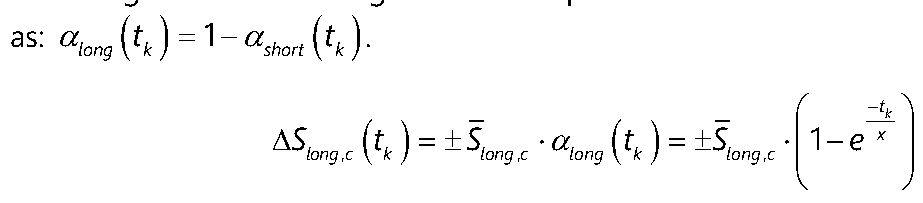
Long rate shock for currency c (note: this is used only in the rotational shocks): Here the shock is greatest at the longest tenor midpoint and is related to the short scaling factor
Equation, page 28 of the PDF
(4)
Rotation shocks for currency c: involving rotations to the term structure (ie steepeners and flatteners) of the interest rates whereby both the long and short rates are shocked and the shift in interest rates at each tenor midpoint is obtained by applying the following formulas to those shocks:
Equation, page 28 of the PDF
  1. 9 The value of x in the denominator of the function e x controls the rate of decay of the shock. This should be set to the value of 4 for most currencies and the related shocks unless otherwise determined by national supervisors. tk is the midpoint (in time) of the kth bucket and tK is the midpoint (in time) of the last bucket K. There are 19 buckets in the standardised framework, but the analysis may be generalised to any number of buckets.

The following examples illustrate the scenarios in [SRP31.95(2)] and [SRP31.95(4)].

(1)
Short rate shock: Assume that the bank uses the standardised framework with K = 19 time bands and with tK = 25 years (the midpoint (in time) of the longest tenor bucket K), and where tK is the midpoint (in time) for bucket k. In the standardised framework, if k = 10 with tk = 3.5 years, the scalar adjustment for the short shock would be αshort(tk)= e4 = 0.417. Banks would multiply this by the value of the short rate shock to obtain the amount to be added to or subtracted from the yield curve at that tenor point. If the short rate shock was +100 basis points (bp), the increase in the yield curve at tk = 3.5 years would be 41.7 bp.
Show the maths as printed
Line as printed, with the equation
(2)
Steepener: Assume the same point on the yield curve as above, tk = 3.5 years. If the absolute value of the short rate shock was 100 bp and the absolute value of the long rate shock was 100 bp (as for the Japanese yen), the change in the yield curve at tk = 3.5 years would be the sum of the effect of the short rate shock plus the effect of the long rate shock in bp: −0.65 x 100 bp x 0.417 + 0.9 x 100 bp x (1−0.417) = +25.4 bp.
(3)
Flattener: The corresponding change in the yield curve for the shocks in the example above at tk = 3.5 years would be: +0.8 x 100 bp x 0.417 – 0.6 x 100 bp x (1−0.417) = −1.6 bp.

The Committee acknowledges that shock sizes of different currencies should reflect local conditions in a timely manner. For this reason, the Committee will review the calibration of the interest rate shock sizes (eg every five years). National supervisors may, at their discretion, set floors for the post-shock interest rates under the six interest rate shock scenarios, provided the floors are not greater than zero.

The standardised framework

Supervisors could mandate their banks to follow the framework set out in this section, or a bank could choose to adopt it.

The steps involved in measuring a bank’s IRRBB, based solely on EVE, are:

(1)
Interest rate-sensitive banking book positions are allocated to one of three categories (ie amenable, less amenable and not amenable to standardisation).
(2)
Determination of slotting of cash flows based on repricing maturities. This is a straightforward translation for positions amenable to standardisation. For positions less amenable to standardisation, they are excluded from this step. For positions with embedded automatic interest rate options, the optionality should be ignored for the purpose of slotting of notional repricing cash flows.10 For positions that are not amenable to standardisation, there is a separate treatment for:
(a)
NMDs – according to separation of core and non-core cash flows via the approach set out in [SRP31.111] to [SRP31.116].
(b)
Behavioural options (fixed rate loans subject to prepayment risk and term deposits subject to early redemption risk) – behavioural parameters relevant to the position type must rely on a scenario-dependent look-up table set out in [SRP31.123] and [SRP31.129].
(3)
Determination of ∆EVE for relevant interest rate shock scenarios for each currency. The ∆EVE is measured per currency for all six prescribed interest rate shock scenarios.
(4)
Add-ons for changes in the value of automatic interest rate options (whether explicit or embedded) are added to the EVE changes. Automatic interest rate options sold are subject to full revaluation (possibly net of automatic interest rate options bought to hedge sold interest rate options) under each of the six prescribed interest rate shock scenarios for each currency. Changes in values of options are then added to the changes in the EVE measure under each interest rate shock scenario on a per currency basis.
(5)
IRRBB EVE calculation. The ∆EVE under the standardised framework will be the maximum of the worst aggregated reductions to EVE across the six supervisory prescribed interest rate shocks.
  1. 10 That is, the embedded automatic interest rate option is stripped out from the process of slotting notional repricing cash flows in Step 2 and treated together with other automatic interest rate options under Step 4.

Banks must project all future notional repricing cash flows arising from interest rate-sensitive assets, liabilities and off-balance sheet items on to:

(1)
19 predefined time buckets (indexed numerically by k) as set out in Table 3, into which they fall according to their repricing dates, or
(2)
the time bucket midpoints as set out in Table 3, retaining the notional repricing cash flows’ maturity. This alternative requires splitting up notional repricing cash flows between two adjacent maturity bucket midpoints.
Maturity schedule with 19 time buckets for notional repricing cash flows repriciting at tCF The number in brackets is the time bucket’s midpoint Table 3
Time bucket intervals (M = months; Y = years)
Short-term ratesOvernight (0.0028Y)Overnight < tCF ≤ 1M (0.0417Y)1M < tCF ≤ 3M (0.1667Y)3M < tCF ≤ 6M (0.375Y)6M < tCF ≤ 9M (0.625Y)9M < tCF ≤ 1Y (0.875Y)1Y < tCF ≤ 1.5Y (1.25Y)1.5Y < tCF ≤ 2Y (1.75Y)
Medium-term rates2Y < tCF ≤ 3Y (2.5Y)3Y < tCF ≤ 4Y (3.5Y)4Y < tCF ≤ 5Y (4.5Y)5Y < tCF ≤ 6Y (5.5Y)6Y < tCF ≤ 7Y (6.5Y)
Long-term rates7Y < tCF ≤ 8Y (7.5Y)8Y < tCF ≤ 9Y (8.5Y)9Y < tCF ≤ 10Y (9.5Y)10Y < tCF ≤ 15Y (12.5Y)15Y < tCF ≤ 20Y (17.5Y)tCF > 20Y (25Y)

For the purpose of this approach, assets are those not deducted from CET1 capital and exclude fixed assets (such as real estate or intangible assets) and equity exposures in the banking book. Liabilities include all non-remunerated deposits but exclude CET1 capital under the Basel III framework.

A notional repricing cash flow CF(k) is defined as:

(1)
any repayment of principal (eg at contractual maturity);
(2)
any repricing of principal; repricing is said to occur at the earliest date at which either the bank or its counterparty is entitled to unilaterally change the interest rate, or at which the rate on a floating rate instrument changes automatically in response to a change in an external benchmark; or
(3)
any interest payment on a tranche of principal that has not yet been repaid or repriced; spread components of interest payments on a tranche of principal that has not yet been repaid and which do not reprice must be slotted until their contractual maturity irrespective of whether the non-amortised principal has been repriced or not.

The date of each repayment, repricing or interest payment is referred to as its repricing date.

Banks have the choice of whether to deduct commercial margins and other spread components from the notional repricing cash flows, using a prudent and transparent methodology.

Floating rate instruments are assumed to reprice fully at the first reset date. Hence, the entire principal amount is slotted into the bucket in which that date falls, with no additional slotting of notional repricing cash flows to later time buckets or time bucket midpoints (other than the spread component which is not repriced).

All notional repricing cash flows associated with interest rate-sensitive assets, liabilities and off-balance sheet items, for each currency, are allocated to the prescribed time buckets or time bucket midpoints (henceforth, denoted by CFi,c(k) or CFi,c(tk) under interest rate shock scenario i and currency c) based on their amenability to standardisation.

Notional repricing cash flows can be slotted into appropriate time buckets or time bucket midpoints based on their contractual maturity, if subject to fixed coupons, or into the next repricing period if coupons are floating. Positions amenable to standardisation fall into two categories:

(1)
Fixed rate positions: such positions generate cash flows that are certain till the point of contractual maturity. Examples are fixed rate loans without embedded prepayment options, term deposits without redemption risk and other amortising products such as mortgage loans. All coupon cash flows and periodic or final principal repayments should be allocated to the time bucket midpoints closest to the contractual maturity.
(2)
Floating rate positions: such positions generate cash flows that are not predictable past the next repricing date other than that the present value would be reset to par. Accordingly, such instruments can be treated as a series of coupon payments until the next repricing and a par notional cash flow at the time bucket midpoint closest to the next reset date bucket.

Positions amenable to standardisation include positions with embedded automatic interest rate options where the optionality (whether sold or bought) should be ignored for the purpose of slotting of notional repricing cash flows.11 That is, the stripped-out embedded automatic interest rate option must be treated together with explicit automatic interest rate options. Supervisors may allow banks to categorise other positions as amenable to standardisation and ignore the optionality if it can be shown to be of immaterial consequence.

  1. 11 For example, a floating rate loan or debt security with a floor would be treated as if there were no floor; hence it would be treated as if it fully repriced at the next reset date, and its full outstanding balance slotted in the corresponding time band. Similarly, a callable bond issued by a bank at a fixed yield would be treated as if it matured at its longest contractual term, ignoring the call option.

Some positions are less amenable to standardisation.12 For explicit automatic interest rate options, as well as embedded automatic interest rate options13 that are separated or stripped out from the bank’s assets or liabilities (ie the host contract), the methodology for automatic interest rate options is described in [SRP31.131] and [SRP31.132].

  1. 12 A common feature of these positions is optionality that makes the timing of notional repricing cash flows uncertain. This optionality introduces a non-linearity, which suggests that delta-equivalent approximations are imprecise for large interest rate shock scenarios.
  2. 13 An example of a product with embedded automatic interest rate options is a floating rate mortgage loan with embedded caps and/or floors. Notional repricing cash flows for those loans are treated as a fixed rate loan until the next repricing date, thereby ignoring the option, which instead is treated like a separate automatic interest rate option.

Positions not amenable to standardisation include

(1)
NMDs,
(2)
fixed rate loans subject to prepayment risk and
(3)
term deposits subject to early redemption risk.

Under the standardised framework, banks should first separate their NMDs according to the nature of the deposit and depositor. Banks should then identify, for each category, the core and non-core deposits, up to the limits specified in Table 4. Finally, banks should determine an appropriate cash flow slotting for each category, in accordance with the average maturity limits specified in Table 4.

NMDs must be segmented into retail and wholesale categories. Retail deposits are defined as deposits placed with a bank by an individual person. Deposits made by small business customers and managed as retail exposures are considered as having similar interest rate risk characteristics to retail accounts and thus can be treated as retail deposits (provided the total aggregated liabilities raised from one small business customer are less than €1 million). Retail deposits should be considered as held in a transactional account when regular transactions are carried out in that account (eg when salaries are regularly credited) or when the deposit is non-interest bearing.14 Other retail deposits should be considered as held in a non-transactional account. Deposits from legal entities, sole proprietorships or partnerships are captured in wholesale deposit categories.

  1. 14 A specific category may be introduced for non-remunerated deposits, subject to supervisory approval.

Banks should distinguish between the stable and the non-stable parts of each NMD category using observed volume changes over the past 10 years. The stable NMD portion is the portion that is found to remain undrawn with a high degree of likelihood. Core deposits are the proportion of stable NMDs which are unlikely to reprice even under significant changes in the interest rate environment. The remainder constitutes non-core NMDs.

Banks are required to estimate their level of core deposits using this two-step procedure for each deposit category, and then to aggregate the results to determine the overall volume of core deposits subject to imposed caps as shown in Table 4.

NMDs should finally be slotted into the appropriate time bucket or time bucket midpoint. Non-core deposits should be considered as overnight deposits and accordingly should be placed into the shortest/overnight time bucket or time bucket midpoint.

Banks should determine an appropriate cash flow slotting procedure for each category of core deposits, up to the maximum average maturity per category as specified in Table 4.

Caps on core deposits and average maturity by category Table 4
Cap on proportion of core deposits (%)Cap on average maturity of core deposits (years)
Retail / transactional905
Retail / non-transactional704.5
Wholesale504

The treatment set out [SRP31.118] to [SRP31.130] applies only to behavioural options related to retail customers. Where a wholesale customer has a behavioural option that may change the pattern of notional repricing cash flows, such options must be included within the category of automatic interest rate options.15

  1. 15 An example of such an option would be a puttable fixed coupon bond issued by the bank in the wholesale market, for which the owner has the right to sell the bond back to the bank at a fixed price at any time.

The standardised framework is applied to fixed rate loans subject to prepayments and term deposits subject to early redemption risk. In each case, the customer has an option, which, if exercised, will alter the timing of a bank’s cash flows. The customer’s exercise of the option is, among other factors, influenced by changes in interest rates. In the case of the fixed rate loan, the customer has an option to repay the loan early (ie prepay); and for a fixed-term deposit, the customer may have an option to withdraw their deposit before the scheduled date.

Under the standardised framework, the optionality in these products is estimated using a two-step approach. Firstly, baseline estimates of loan prepayments and early withdrawal of fixed-term deposits are calculated given the prevailing term structure of interest rates.16

  1. 16 These baseline parameter estimates may be determined by the bank subject to supervisory review and approval, or prescribed by the supervisor.

In the second stage, the baseline estimates are multiplied by scenario-dependent scalars that reflect the likely behavioural changes in the exercise of the options.

Prepayments, or parts thereof, for which the economic cost is not charged to the borrower, are referred to as uncompensated prepayments. For loan products where the economic cost of prepayments is never charged, or charged only for prepayments above a certain threshold, the standardised framework for fixed rate loans subject to prepayments set out below must be used to assign notional repricing cash flows.

Banks must determine or supervisors prescribe the baseline conditional prepayment rate for each portfolio p of homogeneous prepayment-exposed loan products denominated in currency c, under the prevailing term structure of interest rates.

The conditional prepayment rate (CPR) for each portfolio 𝑝 of homogeneous prepayment-exposed loan products denominated in currency c, under interest rate scenario i, is given using the formula that follows, where CPR0p,c is the (constant) base CPR of a portfolio p of homogeneous prepayment-exposed loans given in currency c17 and given the prevailing term structure of interest rates. γi is a multiplier applied for scenario i as given in Table 5.

Show the maths as printed
Line as printed, with the equation
Equation, page 34 of the PDF
CPRs under the shock scenarios Table 5
Scenario number (i)Interest rate shock scenariosγi (scenario multiplier)
1Parallel up0.8
2Parallel down1.2
3Steepener0.8
4Flattener1.2
5Short rate up0.8
6Short rate down1.2
  1. 17 Alternatively, the base CPR may also vary over the life of each loan in the portfolio. In that case, it is denoted asCPR(k)0p,c for each time bucket k or time bucket midpoint tk.

Prepayment speeds vary according to the interest rate shock scenario. The multipliers (γi) reflect the expectation that prepayments will generally be higher during periods of falling interest rates and lower during periods of rising interest rates.

The prepayments on the fixed rate loans must ultimately be reflected in the relevant cash flows (scheduled payments on the loans, prepayments and interest payments). These payments can be broken up into scheduled payments adjusted for prepayment and uncompensated prepayments18 according to the following formula, whereCFiS,c(k) refers to the scheduled interest and principal repayment, and Nip,c(k−1) denotes the notional outstanding at time bucket k–1. The base cash flows (ie given the current interest rate yield curve and the base CPR) are given by i=0, while the interest rate shock scenarios are given for i=1 to 6.

Show the maths as printed
Line as printed, with the equation
Equation, page 34 of the PDF
  1. 18 For simplicity, we have assumed there is no annual limit on prepayments. If a bank has an annual limit on uncompensated prepayments, this limit will apply.

Term deposits lock in a fixed rate for a fixed term and would usually be hedged on that basis. However, term deposits may be subject to the risk of early withdrawal, also called early redemption risk. Consequently, term deposits may only be treated as fixed rate liabilities and their notional repricing cash flows slotted into the time buckets or time bucket midpoints up to their corresponding contractual maturity dates if it can be shown to the satisfaction of the supervisor that:

(1)
the depositor has no legal right to withdraw the deposit; or
(2)
an early withdrawal results in a significant penalty that at least compensates for the loss of interest between the date of withdrawal and the contractual maturity date and the economic cost of breaking the contract.19
  1. 19 However, often penalties do not reflect such an economic calculation but instead are based on a simpler formula such as a percentage of accrued interest. In such cases, there is potential for changes to profit or loss arising from differences between the penalty charged and the actual economic cost of early withdrawal.

If neither of these conditions is met, the depositor holds an option to withdraw and the term deposits are deemed to be subject to early redemption risk. Further, if a bank issues term deposits that do not meet the above criteria to wholesale customers, it must assume that the customer will always exercise the right to withdraw in the way that is most disadvantageous to the bank (ie the deposit is classified as an automatic interest rate option).

Banks must determine or supervisors prescribe the baseline term deposit redemption ratio TDRRop,c applicable to each homogeneous portfolio p of term deposits in currency c and use it to slot the notional repricing cash flows. Term deposits which are expected to be redeemed early are slotted into the overnight time bucket (k=1) or time bucket midpoint (t1).

The term deposit redemption ratio for time bucket k or time bucket midpoint tk applicable to each homogeneous portfolio p of term deposits in currency c and under scenario i is obtained by multiplying TDRRop,c by a scalar ui (set out in Table 6) that depends on the scenario i, as follows:

Equation, page 35 of the PDF
Term deposit redemption rate (TDRR) under the shock scenarios Table 6
Scenario number (i)Interest rate shock scenariosScalar multipliers ui
1Parallel up1.2
2Parallel down0.8
3Steepener0.8
4Flattener1.2
5Short rate up1.2
6Short rate down0.8

The notional repricing cash flows which are expected to be withdrawn early under any interest rate shock scenario i are described as follows, whereTD0p,c is the outstanding amount of term deposits of type p.

Equation, page 35 of the PDF

This paragraph and [SRP31.132] describe the method for calculating an add-on for automatic interest rate options, whether explicit or embedded.20 This applies to sold automatic interest rate options. Banks have a choice to either include all bought automatic options or include only automatic options used for hedging sold automatic interest rate options:

(1)
For each sold automatic option o in currency c, the value change, denotedVFVAOio,c , is calculated for each interest rate shock scenario i. The value change is given by:
Show the maths as printed
Line as printed, with the equation
(a)
an estimate of the value of the option to the option holder,21 given:
(i)
a yield curve in currency c under the interest rate shock scenario 𝑖; and
Show the maths as printed
Line as printed, with the equation
(ii)
a relative increase in the implicit volatility of 25%; minus
(b)
the value of the sold option to the option holder, given the yield curve in currency c at the valuation date.
(2)
Likewise, for each bought automatic interest rate option q, the bank must determine the change in value of the option between interest rate shock scenario i and the current interest rate term structure combined with a relative increase in the implicit volatility of
Equation, page 36 of the PDF
(3)
The bank’s total measure for automatic interest rate option risk under interest rate shock scenario i in currency c is calculated as follows, where nc (mc) is the number of sold (bought) options in currency c.
Equation, page 36 of the PDF
  1. 20 The most important automatic interest rate options likely to occur in the banking book are caps and floors, which are often embedded in banking products. Swaptions, such as prepayment options on non-retail products, may also be treated as automatic interest rate options, as, in cases where such options are held by sophisticated financial market counterparties, the option holder will almost certainly exercise the option if it is in their financial interest to do so. Any behavioural option positions with wholesale customers that may change the pattern of notional repricing cash flows are considered as embedded automatic interest rate options for the purposes of this subsection.
  2. 21 This estimate requires a methodology approved by the supervisor.

If the bank chooses to only include bought automatic interest rate options that are used for hedging sold automatic interest rate options, the bank must, for the remaining bought options, add any changes in market values reflected in the regulatory capital measure of the respective capital ratio (ie CET1, Additional Tier 1 or total capital) to the total automatic interest rate option risk measure KAOi,c.

First, the loss in economic value of equity ΔEVEi,c under scenario i and currency c is calculated for each currency with material exposures, ie those accounting for more than 5% of either banking book assets or liabilities, as follows:

(1)
Under each scenario i, all notional repricing cash flows are slotted into the respective time bucket k ⋲ {1, 2, …, K} or time bucket midpoint tk, k ⋲ {1, 2, …, K}. Within a given time bucket k or time bucket midpoint tk, all positive and negative notional repricing cash flows are netted22 to form a single long or short position, with the cancelled parts removed from the calculation. Following this process across all time buckets or time bucket midpoints leads to a set of notional repricing cash flows CFi,c(k) or CFi,c(tk), k ⋲ {1, 2, …, K}.23
(2)
Net notional repricing cash flows in each time bucket k or time bucket midpoint tk are weighted by a continuously compounded discount factor, described below, that reflects the interest rate shock scenario i in currency c as set out in [SRP31.94] to [SRP31.97], and where tk is the midpoint of time bucket k. This results in a weighted net position, which may be positive or negative for each time bucket. The cash flows should be discounted using either a risk-free rate24 or a risk-free rate including commercial margin and other spread components (only if the bank has included commercial margins and other spread components in its cash flows).
Equation, page 36 of the PDF
(3)
These risk-weighted net positions are summed to determine the EVE in currency c under scenario i (excluding automatic interest rate option positions):
Equation, page 37 of the PDF
(4)
Then, the full change in EVE in currency c associated with scenario i is obtained by subtractingEVEin,cao from the EVE under the current interest rate term structureEVE0n,aco and by adding the total measure for automatic interest rate option risk KAOi,c, as follows:
Equation, page 37 of the PDF
  1. 22 Intra-bucket mismatch risk arises as notional repricing cash flows with different maturity dates, but falling within the same time bucket or time bucket midpoint, are assumed to match perfectly. This is mitigated by introducing a high number of time buckets (ie K=19).
  2. 23 Note that, depending on the approach taken for NMDs, prepayments and products with other embedded behavioural options, the notional repricing cash flows may vary by scenario 𝑖 (scenario-dependent cash flow products).
  3. 24 The discounting factors must be representative of a risk-free zero coupon rate. An example of an acceptable yield curve is a secured interest rate swap curve.
  4. 25 National supervisors would, however, be allowed to prescribe a different method of currency aggregation for their banks, if the national supervisor is able to support, with evidence, that such a method would remain in line with the jurisdiction’s appetite for IRRBB.

SRP98 edits

Chapter details
Standard acronymSRP
Standard nameSupervisory review process
Description of standardThe Pillar 2 supervisory review process ensures that banks have adequate capital and liquidity to support all the risks in their business, especially with respect to risks not fully captured by the Pillar 1 process, and encourages good risk management.
Chapter acronymSRP98
Chapter nameElaboration and application guidance on interest rate risk in the banking book
Description of chapterThis chapter elaborates on the guidance for the banks and supervisors described in SRP31 in areas where they are considered desirable for the supervision of banks and contains a detailed description of interest rate risk in the banking book, its management techniques and the derivation of the standardised interest rate shocks.
Version effective from
Change description

Definition of interest rate risk in the banking book

Interest rate risk in the banking book (IRRBB) refers to the current or prospective risk to a bank’s capital and to its earnings, arising from the impact of adverse movements in interest rates on its banking book.

Excessive IRRBB can pose a significant threat to a bank’s current capital base or future earnings if not managed appropriately. Changes in interest rates can affect the underlying economic value of the bank’s assets, liabilities and off-balance sheet instruments, because the present value of future cash flows (and, in many cases, the amounts of cash flows themselves) change when interest rates change. Changes in interest rates also affect a bank’s earnings by increasing or decreasing its net interest income (NII) and the level of other interest rate-sensitive income and operating expenses.

Fundamentally, there are two distinct methods for valuing banking book items, namely:

(1)
“amortised” (or “historical”) cost, where values are based on initial cost less accumulated depreciation, taking account of the expected life / maturity of the item; and
(2)
“fair” (or “market”) value, where values are based on market prices (where available) or on the net present value of expected cash flows, discounted at the prevailing rate (where no market price is available).

For items held at amortised cost, market interest rate changes do not significantly impact profit recognition or accounting values for existing instruments (significant changes in values would be from impairment that needs to be recognised as a permanent diminution in value). Income/cost on items held at amortised cost therefore emerges over time in line with maturity-adjusted cash flows.1

  1. 1 However, the accounting value may not be the same as the balance that needs to be managed for IRRBB purposes, because of the impact of effective interest rate calculations and the treatment of loan loss provisions.

Accounting values of fair valued instruments can vary significantly from period to period, due to changes to external factors (eg interest rate changes can impact both the expected future cash flows and the discount rate used for calculation purposes). Income and cost are recognised either through profit and loss (P&L) or through equity, on the basis of changes to embedded value.

Since most IRRBB economic value measures aim to estimate the change in economic value under shocks and stresses, the presence or absence of higher/lower accounting values for amortised cost instruments is effectively ignored, as is the emergence of profit over time. It is therefore important to note that a loss in economic value does not automatically equate with accounting losses for this element of the banking book. Conversely, for assets held at fair value/mark-to-market, changes in interest rates directly affect current accounting values, and thus have an immediate impact on both P&L and available capital.

Every interest rate earned by a bank on its assets, or paid on its liabilities, is a composite of a number of price components – some more easily identified than others. Theoretically, all rates contain five elements.

(1)
The risk-free rate: this is the fundamental building block for an interest rate, representing the theoretical rate of interest an investor would expect from a risk-free investment for a given maturity.
(2)
A market duration spread: the prices/valuations of instruments with long durations are more vulnerable to market interest rate changes than those with short durations. To reflect the uncertainty of both cash flows and the prevailing interest rate environment, and consequent price volatility, the market requires a premium or spread over the risk-free rate to cover duration risk.
(3)
A market liquidity spread: even if the underlying instrument were risk-free, the interest rate may contain a premium to represent the market appetite for investments and the presence of willing buyers and sellers.
(4)
A general market credit spread: this is distinct from idiosyncratic credit spread, and represents the credit risk premium required by market participants for a given credit quality (eg the additional yield that a debt instrument issued by an AA-rated entity must produce over a risk-free alternative).
(5)
Idiosyncratic credit spread: this reflects the specific credit risk associated with the credit quality of the individual borrower (which will also reflect assessments of risks arising from the sector and geographical/currency location of the borrower) and the specifics of the credit instrument (eg whether a bond or a derivative).

In theory these rate components apply across all types of credit exposure, but in practice they are more readily identifiable in traded instruments (eg bonds) than in pure loans. The latter tend to carry rates based on two components:

(1)
The funding rate, or a reference rate plus a funding margin: the funding rate is the blended internal cost of funding the loan, reflected in the internal funds transfer price (for larger and more sophisticated banks); the reference rate is an externally set benchmark rate, such as the London Interbank Offered Rate (LIBOR) or the federal funds rate, to which a bank may need to add (or from which it may need to subtract) a funding margin to reflect its own all-in funding rate. Both the funding rate and the reference rate incorporate liquidity and duration spread, and potentially some elements of market credit spread. However, the relationship between the funding rate and market reference rate may not be stable over time – this divergence is an example of basis risk.
(2)
The credit margin (or commercial margin) applied: this can be a specific add-on (eg LIBOR + 3%, where the 3% may include an element of funding margin) or built into an administered rate (a rate set by and under the absolute control of the bank).

In practice, decomposing interest rates into their component parts is technically demanding and the boundaries between the theoretical components cannot easily be calculated (eg changes to market credit perceptions can also change market liquidity spreads). As a result, some of the components may be aggregated for interest rate risk management purposes.

Changes to the risk-free rate, market duration spread, reference rate and funding margin all fall within the definition of IRRBB. Changes to the market liquidity spreads and market credit spreads are combined within the definition of credit spread risk in the banking book (CSRBB). The diagram below gives a visual representation of how the various elements fit together.

The main driver of IRRBB is a change in market interest rates, both current and expected, as expressed by changes to the shape, slope and level of a range of different yield curves that incorporate some or all of the components of interest rates.

When the level or shape of a yield curve for a given interest rate basis changes, the relationship between interest rates of different maturities of the same index or market, and relative to other yield curves for different instruments, is affected. This may result in changes to a bank’s income or underlying economic value.

CSRBB is driven by changes in market perception about the credit quality of groups of different credit-risky instruments, either because of changes to expected default levels or because of changes to market liquidity. Changes to underlying credit quality perceptions can amplify the risks already arising from yield curve risk. CSRBB is therefore defined as any kind of asset/liability spread risk of credit-risky instruments which is not explained by IRRBB, nor by the expected credit/jump-to-default risk.

This chapter and [SRP31] focus mainly on IRRBB. CSRBB is a related risk that needs to be monitored and assessed.

IRRBB derives from three fundamental aspects relating to the level and structural characteristics of interest rates, and the effects on these of changes to yield curves. These aspects of interest rate risk can occur simultaneously, and therefore need to be managed holistically.

(1)
Gap risk arises from the term structure of banking book instruments, and describes the risk arising from the timing of instrument rate changes. Since rate resets on different instruments occur at different tenors, the risk to the bank arises when the rate of interest paid on liabilities increases before the rate of interest received on assets, or reduces on assets before liabilities. Unless hedged in terms of tenor and amount, the bank may be exposed to a period of reduced or negative interest margins, or may experience changes in the relative economic values of assets and liabilities. The extent of gap risk depends also on whether changes to the term structure of interest rates occur consistently across the yield curve (parallel risk) or differentially by period (non-parallel risk).2
(2)
Basis risk describes the impact of relative changes in interest rates for financial instruments that have similar tenors but are priced using different interest rate indices (bases) (eg an asset priced off LIBOR funded by a liability priced off US Treasuries). It arises from the imperfect correlation in the adjustment of the rates earned and paid on different instruments with otherwise similar rate change characteristics. For the purposes of this chapter, IRRBB is defined as excluding changes in idiosyncratic credit margins.
(3)
Option risk arises from option derivative positions or from the optional elements embedded in many bank assets, liabilities and off-balance sheet items, where the bank or its customers can alter the level and timing of their cash flows. For IRRBB purposes, option risk can be broken down into two distinct but related sub-types:
(a)
automatic option risk arising from standalone instruments, such as exchange-traded and over-the-counter option contracts, or explicitly embedded within the contractual terms of an otherwise standard financial instrument (eg a capped rate loan) and where the holder will almost certainly exercise the option if it is in their financial interest to do so; and
(b)
behavioural option risk arising from flexibility embedded implicitly or within the terms of financial contracts, such that changes in interest rates may effect a change in the behaviour of the client (eg rights of a borrower to prepay a loan, with or without penalty, or the right of a depositor to withdraw their balance in search of higher yield).
  1. 2 This may sometimes be referred to as “yield curve risk”.

In addition to the pure economic risks that can arise from changes to the level and structure of interest rates, risks can arise from:

(1)
currency mismatches, ie where the interest rate risks are in addition to normal exchange rate risks (this falls within a wider definition of basis risk); or
(2)
accounting treatment of risk positions, ie where interest rate hedging activity may achieve the desired economic effect, but fail to achieve hedge accounting treatment.

Measurement of IRRBB

There are two complementary methods of measuring the potential impact of IRRBB:

(1)
changes in expected earnings (earnings-based measures); and
(2)
changes in economic value (EV, or EVE when measuring the change in value relative to equity).

The two methods are complementary in that:

(1)
both measures reflect the impact of changing cash flows arising from changing interest rates;
(2)
the change in expected earnings is reflected in the change in economic value; and
(3)
they are affected by common assumptions.

The key differences between the measures include:

(1)
Outcome measure: EV measures compute a change in the net present value of the balance sheet under an interest rate stress. In undertaking such a calculation, a decision has to be made about whether the outcome should be computed as a change in the theoretical economic value of equity (EVE) – in which case, equity is either excluded from the EV calculation or included with a very short (overnight) duration; or whether the outcome should measure the change in economic value other than for assets representing equity – in which case, equity is either included with the same duration as the assets which it is deemed to be financing, or else both equity and its portfolio of financed assets are excluded (this is earnings-adjusted EV). EVE and earnings-adjusted EV are therefore specific forms of an EV measure. All EV measures can be expressed relative to equity, but EVE includes the change to equity value that would result from revaluing under stress its own financed portfolio of assets. Earnings-based measures focus on changes to future profitability. To the extent that future earnings eventually affect levels of future equity, the two measures are aligned, but the value changes estimated include adjustments to net income that occur beyond the horizon for earnings measures.
(2)
Time horizon: EV measures reflect changes in value relative to equity over the remaining life of the balance sheet, ie until all positions have run off. Earnings-based measures cover only the short to medium term, and therefore do not capture in full those risks that will continue to impact profit and loss accounts beyond the period of estimation.
(3)
Future transactions: EV measures usually just focus on changes to cash flows of instruments already on the balance sheet. Earnings-based measures can be based on balance sheet run-off, or a static balance sheet, but more sophisticated or dynamic models tend to consider the impact of new business/production that is expected to be written in the future, as well as the run-off of existing business.

For earnings-based measures, the focus for analysis is the impact of changes in interest rates on future accrued or reported earnings.

The component of earnings that has traditionally received the most attention is NII, ie the difference between total interest income and total interest expense, taking account of hedging activity (eg via derivatives). This focus reflects both the importance of NII in banks’ overall earnings and its direct link to changes in interest rates.3

  1. 3 Note, however, that, as some banks have expanded increasingly into activities that generate fee-based and other non-interest income, a broader focus on operating earnings/overall net income, incorporating both interest and non-interest income and expenses, has become more common.

An earnings-based measure offers the possibility of measuring risk under a range of different time horizons. The normal focus is on the short/medium-term horizon (typically one to three years, no more than five years), to limit the cumulative impact of underlying assumptions and the complexity of the calculations. As a consequence, an earnings-based measure is better suited to measuring the short- and medium-term vulnerabilities of the bank to IRRBB, assuming that it is able to continue in business (a going-concern viewpoint).

An earnings-based measure is therefore commonly used to assess the ability of a bank to generate stable earnings over a medium-term horizon, which will allow it to pay a stable level of dividend and reduce the beta on its equity price and therefore reduce its cost of capital. Hence, it is a measure in line with internal management and asset and liability management objectives.

In order to be able to calculate changes in expected earnings under different interest rate shocks and stress scenarios, an institution will need to be able to project future earnings under both the expected economic scenario that informs its corporate plan, and the interest rate shock and stress scenarios so that the differences can be measured. Such projections involve a range of further assumptions about client/market behaviour, and the bank’s own management response to the evolving economic climate, including:

(1)
the volume and type of new/replacement assets and liabilities expected to be originated over the evaluation period;
(2)
the volume and type of asset and liability redemptions/reductions over that period;
(3)
the interest rate basis and margin associated with the new assets and liabilities, and with those redeemed/withdrawn; and
(4)
the impact of any fees collected/paid for exercise of options.

In practical terms, this may result in modelling of earnings under three different states:

(1)
run-off balance sheet: existing assets and liabilities not replaced as they mature, except to the extent necessary to fund the remaining balance sheet;
(2)
constant balance sheet: total balance sheet size and shape maintained by assuming like-for-like replacement of assets and liabilities as they run off; and
(3)
dynamic balance sheet: incorporating future business expectations, adjusted for the relevant scenario in a consistent manner, ie this is the most meaningful approach.

Under an economic value approach, the measure of IRRBB is the theoretical change in the net embedded market value of the whole banking book.

The EV of a tradable instrument is its present value (PV). In the absence of embedded options, the PV of the instrument is determined from its contractual cash flows, which are discounted to reflect current market rates. As a first implication, instruments with short-term or variable rate cash flows have a present value that more nearly equals their face value (ie their carrying value). As a second implication, a change in market rates would not change the EV of such instruments. Third, the PV of an interest rate-sensitive instrument with uncertain contractual cash flows can only be valued on the basis of assumptions about behaviour and timing, which will tend to vary dependent upon external factors.

Applying the concept of EV to the whole balance sheet of a bank is more challenging: the banking book contains assets and liabilities that are accounted for at held-to-maturity valuation, and for which there may not be observable market prices (eg loans and receivables are not as readily marketable and their market value cannot be determined directly). Moreover, there may be embedded under- and overvaluations in the book on a mark-to-market basis, representing income or costs that will emerge in future reported earnings. In addition, margins on loans may be very heterogeneous, thus making determination of an appropriate discount rate problematic, and the cash flows that are being valued are subject to variation depending upon customer behaviour in response to rate changes (and customers may not behave as might rationally be expected). Finally, there may be structural positions (eg assets held to stabilise return on non-maturity deposits and/or equity) which will produce a significant change in value under EV measurement, but where the risk measured is a direct corollary of risk reduction from an earnings volatility perspective.4

  1. 4 For example, a bank with $100 of capital could manage its earnings volatility by investing all capital in a long-dated fixed rate government security – which would lock in a consistent income but produce economic value risk if market rates changed and the mark-to-market value of the security declined. If its aim was to achieve economic value stability, it could invest its capital in the overnight market, but its earnings would then fluctuate with market interest rates. It is not possible for it to eliminate both EV and earnings risks simultaneously, so a trade-off is needed.

To avoid the complexity of measuring total EV, banks typically therefore focus on measuring the level of change to the net present value of the relevant balance sheet items, based on existing or adjusted cash flows that are revalued in line with the interest rate shock and stress scenarios. The change in the valuation is a measure of the level of IRRBB, and can be compared with the current value of equity to determine the change to the EVE.

98.30 New

The short- and medium-term earnings indicators and holistic earnings impact analysis in response to changing rates may include the following measures according to jurisdictional and firm-specific considerations:

(1)
Direct measures of short-term earnings risk arising from sudden interest rate movements such as (NII (shocked) – NII (baseline)) / Tier 1 capital, (NII (shocked) – NII (realised)) / NII (realised) and ΔNII / 3-year average of core operating profit, and other firm-specific measures of NII sensitivity.
(2)
Detailed descriptions of the sources of earnings risks such as projected NII and NII under shocked scenarios (parallel shock up; parallel shock down) broken down by balance sheet item with and without hedging.
(3)
Details on key assumptions and their impact on NII such as repricing approaches and rates, in particular pass-through rates (PTR5). Key information could include, for example, the distribution of balance sheet items across different repricing time buckets, the size and direction of repricing gaps (mismatches between assets and liabilities that reprice in the same period), the institution’s assumptions for assigning products to repricing buckets and the balance sheet assumption used.
(4)
The impact of market value changes of fair value instruments on NII.
(5)
Reverse stress-testing results to identify the conditions under which a bank’s earnings are severely threatened (eg when distributable profits become depleted), and NII sensitivities under the bank’s stress scenarios and horizon (and potentially earnings at risk if relevant in the IRRBB context) to identify key assumptions with a significant impact on the NII measures.
  1. 5 Pass-through rates (or betas) refer to the proportion of the offered rate on a balance sheet instrument compared with a reference rate.
98.31 New

In developing stress scenarios, banks may consider potential sources, severity and measurement of risk under a reasonable range of potential interest rate scenarios, including some containing severe stress elements. Banks may identify and calibrate stress scenarios to execute a series of targeted stress tests to establish risk controls to effectively monitor and manage their risks. In low interest rate environments, banks may also consider negative interest rate scenarios and the possibility of asymmetrical effects of negative interest rates on their assets and liabilities.

98.32 New

When conducting sensitivity testing, sound risk management includes considering multiple levels of rate shocks and non-parallel yield curves, jurisdictions’ discretion over the levels and rate shock scenarios used, and a variety of other factors such as the bank’s risk profile, current economic conditions and the historical and implied volatility of interest rates.

98.33 New

Banks conduct stress tests on a regular basis and more frequently, if warranted, to ensure a timely and effective evaluation of their impact on key business decisions. Through scenario analysis, banks can gauge the impact of these risks by altering a single or a limited set of risk factors, modelling assumptions or parameters.

98.34 New

The holistic monitoring of capital headroom may include:

(1)
Measurement and management of embedded losses: For banks with significant holdings of investment securities, a sound risk management practice is to assess the amount of the embedded losses and gains associated with their portfolio of securities held at amortised cost and report the impact on capital headroom to bank senior management and supervisors.
(2)
Sensitivity of EVE to embedded losses: Although the impact of embedded gains and losses is reflected in EVE, greater transparency on the EVE sensitivity attributable to securities held at amortised cost due to different rate shocks is a better risk management practice.
(3)
Exposure to embedded losses in banks’ securities portfolios: Banks’ portfolios of securities held at amortised cost may be stratified by asset class, maturity, fixed rate and floating rate assets. Summary information about the extent of hedging related to the securities portfolio provided as part of supervisory information as defined in SRP98.77 under “Supervisory assessment of IRRBB” and to bank senior management is also a better practice.
(4)
Stress testing of embedded losses: Supervisory information and the reports provided to bank senior management include results of internal stress tests under high levels of embedded losses and their impact on EVE and capital headroom.

Key considerations and assumptions

98.35 New

The same product types can have different characteristics across and within jurisdictions. Therefore, for banks materially active in different markets, sound risk management considers development of behavioural and modelling assumptions specific to each market.

Both measures of IRRBB are significantly impacted by assumptions made for the purposes of risk quantification:

(1)
the range of shocks to the possible changes in the level, slope and shape of interest rate yield curves that are required to produce an IRRBB effect on EV or earnings, and the economic stress scenarios that would be consistent with these shocks;
(2)
expectations for the exercise of options (explicit and implicit) by both the bank itself and its customers under the given scenarios;
(3)
treatment in risk quantifications of balances and interest flows arising from non-maturity deposits (NMDs);
(4)
the bank’s own determination of the implied investment term of the bank’s own equity capital liability; and
(5)
the implications for IRRBB of adopted accounting practices.

In order to produce a quantitative estimate of IRRBB, it is necessary to assume a shock to current interest rate levels, which would allow the change in EV or earnings, and ultimately the effect on equity, to be computed. The size and shape of the shock will determine the measured outcome, and a range of shocks may be needed to identify all the potential facets of IRRBB (eg basis risks would not be captured by shocks that assume only parallel shifts of similar quantum in all yield curves). Designing interest rate change scenarios that are relevant to the business and sufficiently stressful is a key element of IRRBB management

98.38 Amended

Behaviour of option positions is one of the key set of assumptions that drive risk quantification measures. When developing behavioural models, sound risk management considers relevant segmentation factors and macroeconomic variables using appropriate time series. For the modelling of NMDs, sound risk management includes implementing prudent segmentation based on empirically supported criteria and accounting for depositor heterogeneity, while not solely relying on mechanical or backward-looking approaches.

The approach taken by banks generally differs between automatic options, where the customer and bank can assume that the exercise of options will be based on rational expectations, and behavioural options, where behaviour will not always be rational and behavioural assumptions need to be used instead.

Automatic option positions can therefore be valued on the basis that exercise will always (and only) occur when there is financial benefit (with valuation based on standard financial modelling techniques and the results are fed into EV estimates). The rational expectation that the options will be exercised can also be readily fed into forward projections of interest margin under earnings-based measures.

98.41 Amended

Behavioural option positions require more complex analysis of expected outcomes, since customers may exercise some options even when it is not in their financial interest to do so, or may not exercise options even when it would be to their benefit. In determining the time series used for the development of behavioural models, banks may consider various factors:

(1)
Historical coverage, that includes at least one full interest cycle, or a sufficiently long and representative period as set out in the following paragraphs, supplemented where necessary by forward-looking analysis, to capture sensitivity to various stress scenarios.
(2)
Use of different historical time series depending on scenario, product or behavioural option; for example, banks may assess whether historical data remain representative, considering structural changes such as digitalisation, increased competition and shifts in interest rate regimes.
(3)
Supplementing historical data with current economic indicators to perform forward-looking adjustments and avoid mechanistic application of historical trends.
(4)
Ensuring that related assumptions are fully understood, conceptually sound, documented, rigorously tested and aligned with business strategies.

The most complex area of behavioural analysis is for prepayment options on loans: the right to redeem early may be included voluntarily in a loan contract, or imposed on the lender by operation of national law; there may or may not be early redemption penalties payable, but again the size of these penalties may not reflect the actual economic costs and benefits involved (eg if limited by law or by operation of customer redress policy); and customers may choose to redeem for other reasons than the availability of a new loan at lower cost (eg due housing prices, borrowers’ demographics, changing family composition, tax changes).

However, not all borrowers will act irrationally, and exercise of early redemption options will tend to have a detrimental effect on either an EV or an earnings-based measurement, ie in a classic case of convexity risk, borrowers will tend to repay fixed rate borrowings when rates fall (so that they can borrow again at a lower rate) and retain fixed rate positions when market rates rise (so that banks are unable to lend at the higher rates). In order to manage this redemption or extension risk, banks model their books to establish how much should be hedged, and for what period, in order to match their best expectations of cash flows. Such behavioural modelling is clearly prone to error, and needs frequent updating so that hedge positions can be adjusted. Therefore, when using economic value and earnings-based measures, banks need to review and adjust their calculations to account for any expected behaviours.

The use of economic value and earnings-based measures involves estimating cash flows, but the content and treatment is different: for EV measures, all existing balance sheet items (both principal and interest flows) are discounted at a relevant rate, whereas NII measures include all cash flows, including all margins and principal flows from expected future business, and are normally not discounted.

98.45 New

Sound risk management includes performing sensitivity analyses for key assumptions against the pass-through rates and modelled durations of NMDs to monitor their impact on measured IRRBB for both economic value and earnings-based measures.

NMDs are liabilities of the banks in which the depositor is free to withdraw at any time since they have no contractually agreed maturity date. Notwithstanding, NMD balances have historically proved to be relatively stable in practice, even when market rates change, and balances lost can usually be replaced with new deposits at the same rate – so, overall, NMDs behave differently to other more rate-sensitive funding.6 Any interest paid on NMDs is usually at rates significantly below those paid for wholesale or larger-denomination deposits, so NMD balances have historically represented an important source of stable and cost-effective funding.7

  1. 6 A subset of NMDs is non-interest bearing current accounts, where balances may fluctuate but are generally not interest bearing: current account customers hold balances mainly for transactional purposes, and are more sensitive to service levels.
  2. 7 However, NMD sensitivity may have increased as a result of the sustained period of accommodative monetary policy in some of the world’s largest economies.

In considering IRRBB, the focus for some banks is therefore primarily on managing the risk of earnings volatility arising from NMDs. In order to achieve this, banks first identify core deposits, ie that element of NMDs that can be considered to be particularly stable under different interest rate scenarios so that a behavioural maturity can be ascribed specifically to them and matching assets allocated to stabilise earnings. In assessing core balances, banks discount those elements of transactional accounts which are subject to regular fluctuation (withdrawal followed by re-deposit) and overall seasonality of the NMD book.

The matching book of assets may then be managed dynamically to adjust for changes in levels of core deposits, and to maintain a constant maturity in line with expected behaviour and the bank’s risk appetite. Although the behavioural maturity may be determined to be very long, the matching asset position carries risk to a bank’s EV since, being fixed rate and of some duration, the net present value of this portfolio will vary with general interest rates. The maturity profile chosen will therefore be a compromise between protection of earnings for an extended period and increased risk to EV that could materialise on a shock event (eg a deposit run on NMDs, failure of the bank). Internal risk measures can be used to evaluate the extent and impact of the compromise made.8

  1. 8 One common technique for achieving a constant maturity profile is a replicating portfolio of matching assets that produces a moving average fixed return in line with the risk appetite (eg a portfolio where one sixtieth of the total is reinvested each month for five years fixed will deliver a weighted average maturity of 2.5 years and a moving average of the five-year rate).
98.49 New

Effective NMD modelling generally involves applying robust and empirically supported segmentation rather than assuming all depositors behave similarly. Segmentation may reflect customer type, deposit balance size, product characteristics, insured versus uninsured status, pricing and remuneration features as holistically categorised in the Table 1. In addition, a better practice is for banks to avoid relying solely on standard or predefined categories and explicitly analyse behavioural differences across customer groups. As jurisdictionally appropriate and in line with firm-specific practices related to effective model risk management, sound risk management practices include:

(1)
Considering behavioural drivers, market conditions and concentration effects in the models; appropriate calibration of deposit and pass-through rate assumptions through sound segmentation; and ensuring consistency between pricing assumptions and behavioural modelling, particularly under stress and changing interest rate environments. Banks should not rely exclusively on the standardised framework caps, as they may be insufficiently conservative under certain market conditions and firm-specific risk profiles.
(2)
Conducting analyses of client characteristics to implement sound depositor and account segmentation.
(3)
Recognising that the stability of deposits may vary across the interest rate cycle and not extrapolating historical trends without applying appropriate judgment, considering potential migration between NMDs and term deposits and the remuneration offered by other financial products.
(4)
Having a clear understanding of the primary behavioural drivers that affect NMDs and ensuring that these are adequately reflected in the models. These drivers may arise not only from depositor characteristics and product features, but also from broader factors such as competitive actions, market conditions, the economic environment and institution-specific characteristics (eg market positioning, credit rating and liquidity strength).
(5)
Adopting structured approaches based on deposit types, market conditions and historical trends for calibrating pass-through rate assumptions. Pass-through rate assumptions can reflect differences across deposit types and capture non-linearities arising under stress scenarios, as well as interaction with deposit migration, ensuring consistency between pricing assumptions and behavioural modelling of deposit volumes.

In the same way as with NMDs, a bank’s own equity capital liability represents an important source of structural risk and endowment return – in accounting terms, equity is the net value of assets less liabilities, so it represents assets for which there are no funding liabilities. Equity usually has a cost in the form of a dividend (although not in the case of mutual or cooperative organisations), and banks therefore seek to stabilise the earnings that can be made on assets funded by equity.

The technique involves defining net equity capital that is eligible for behavioural treatment – some assets are non-interest bearing (eg land and buildings) and may be considered to be financed by equity, so the value of equity available for behavioural treatment may be reduced accordingly.9 Since equity capital has no contractual price reset date, banks determine their own strategies for managing the earnings volatility that arises from it using techniques similar to those for NMDs. Given that equity may be written down as a result of losses, regulators will normally focus on the EVE risk associated with any earnings profile ascribed to equity that may materialise as losses under stress events.

  1. 9 Banks may also determine that a portion of equity should remain invested short-term as a buffer against losses that may be incurred under a more general business stress.

Quantifying IRRBB: economic value

Change in economic value can be measured using a variety of techniques, the most common of which are:

(1)
PV01: present value of a single basis point change in interest rates based on gap analysis;
(2)
EVE: economic value of equity; and
(3)
EVaR: economic value at risk.

The techniques differ in their complexity and ability to capture different types of interest rate sensitivity (gap risk (parallel and non-parallel), yield curve risk, basis risk and option risk). Multiple measures of EV sensitivity therefore produce a better overall understanding of risks embedded in the banking book.

Gap analysis can be used to derive the duration profile of the banking book or, equivalently, the profile of the present value of a single basis point change in interest rates (PV01). Gap analysis allocates all relevant interest rate-sensitive assets and liabilities to a certain number of predefined time buckets according to their next contractual reset date. The analysis also allocates equity, NMDs, prepaying loans or other instruments with future cash flows subject to customer behaviours according to general/behavioural assumptions regarding their maturity or reset date. It then measures the arithmetic difference (the gap) between the amounts of assets and liabilities in each time bucket, in absolute terms. Each time bucket gap can be multiplied by an assumed change in interest rates to yield an approximation of the change in NII that would result from an increase in interest rates. This method gives a visual impression of the risk exposure dispersion relative to the repricing profile, reflecting exposures to parallel as well as non-parallel gap risk. It does not, however, quantify this risk.10 The measure assumes that all positions within a particular time bucket mature and reprice simultaneously, ignoring potential basis risks within the gaps.

  1. 10 A variant of the technique, modified duration, could be applied, which shows the relative change in the market value of a financial instrument corresponding to marginal parallel shift of the yield curve (eg by 1 percentage point). The weakness of this technique is that it measures only marginal shifts of the yield curve and works only for parallel shifts.

EV measures mainly focus on valuing the cash flows arising from existing assets and liabilities under different future interest scenarios, ignoring future business flows. The change in EV (ie the change in the NPV of future cash flows as a result of a change in rates) can be calculated across all types of assets and liabilities. When a change in the EV of the whole banking book is calculated, the outcome is highly influenced by the treatment of the bank’s own equity capital liability in the calculation. There are two possible approaches:

(1)
Since accounting equity is the net residual figure that arises from subtracting total liabilities from total assets (including off-balance sheet items), measuring the change in the net present value of those assets and liabilities under a stressed interest rate scenario shows the actual level of risk to the economic value of equity. In this calculation, therefore, no rate or term is applied to equity itself, which is therefore excluded, and the NPV outcome is compared with the starting value of equity in order to measure the proportionate size of the change. This is the EVE measure.
(2)
Given that equity finances surplus assets that earn an endowment return for the bank, the change in value of any asset portfolio that has been created to reduce the volatility of earnings on equity is not a relevant EV risk for the bank (ie it has taken the EV risk specifically to hedge earnings risk). In this calculation, therefore, equity is included in the calculation and treated as having the same interest rate/term characteristics as the portfolio of assets that hedges the earnings on it. The NPV outcome is still compared with the starting value of equity, but measures only risks arising from non-structural positions. This measure is earnings-adjusted EV

EVE measures the theoretical change in the net present value of the balance sheet excluding equity. The measure therefore depicts the change in equity value resulting from an interest rate shock. Under this method, the value of equity under alternative stress scenarios is compared with the value under a base scenario. All cash flows from on-balance sheet and off-balance sheet interest rate-sensitive items in the banking book may be included in the computation. The market value of equity is computed as the present value of asset cash flows, less the present value of liability cash flows, without including assumptions on the interest rate sensitivity of equity. For internal measurement purposes, a bank may complement its computation of EVE with a separate earnings-adjusted EV model that uses assumptions about the investment term of equity, whereby its interest rate sensitivity is taken into account.

The accuracy of the measure is extremely dependent upon the precision of the cash flows calculated, and on the discount rates used in the calculation. When the expected cash flows are calculated, any likelihood that the size and the timing of future cash flows may differ between scenarios depending upon customer behaviour in reaction to the rate environment needs to be considered.

Depending on its specific design, an EV/EVE measure can capture all types of interest rate sensitivity. Gap risk (parallel and non-parallel) will be captured depending on the specific yield curve risk used in the alternative scenario. In computing EV, a full revaluation of automatic options would be normal under each of the alternative scenarios, so automatic option risk measurement is an integral part of a standard EV measure. Behavioural optionality can also be captured if stressed behavioural assumptions are used in alternative scenarios. Banks can then compute the EV effect of a change in customer behaviour either separately or in conjunction with a yield curve shift.

EV is a technique that can also be used to estimate basis risk in the banking book, either in isolation, or when combined with a general yield curve shift or with a change in assumed parameters. Basis risk can be measured by designing a scenario under which there is a divergence in the different base rates to which a bank is specifically sensitive.

Economic value at risk (EVaR) measures the expected maximum reduction of market value that can be incurred under normal market circumstances over a given time horizon or holding period and subject to a given confidence level. For calculation of EVaR in the banking book, the changes in the market value of the banking book and thus of the equity are computed for a set of alternative yield curve scenarios. When the EVaR approach is applied to the banking book, the time horizon is normally consistent with the economic model of the banking book. The standard VaR approach comprises three different techniques: historical simulation, variance-covariance approach11 and Monte Carlo simulation.

  1. 11 Under this approach, interest rates of different tenors are derived from historical observations of changes and a variance-covariance matrix is constructed to account for the correlations between the rate shocks across tenors.

EVaR models are suited to capture all types of interest rate sensitivity such as EVE. However, EVaR measurement techniques have their limitations. EVaR is designed for normal market circumstances and does not adequately assess tail risk. Both historical value-at-risk (VaR) and variance-covariance VaR are backward-looking methods which are prone to missing the tail events that carry significant risks. The Monte Carlo simulation method is very demanding in terms of technology and computational power.

Quantifying IRRBB: earnings-based measures

Earnings-based measures look at the expected increase or reduction in NII over a shorter time horizon (typically one to three years, up to a maximum five years) resulting from interest rate movements that are composed of either a gradual or a one-time large interest rate shock. The change in NII is the difference in the expected NII between a base scenario and an alternative, more stressful scenario. The base case scenario reflects the bank’s current corporate plan in projecting the volume, pricing and repricing dates of future business transactions. Interest rates used for resetting transactions in the base scenario can be derived from market expected rates or from spot rates. The rate for each instrument will also contain appropriate projected spreads and margins.

In assessing the possible extent of change in NII, banks can use models to predict the path of rates and the run-off of existing assets and liabilities. Earnings measures can be differentiated according to the complexity of their forward calculations of income, from simple run-off models which assume that existing assets and liabilities mature without replacement, to constant balance sheet models which assume that assets and liabilities are replaced like for like, to the most complex dynamic models which reflect the changes in the volumes and types of business that will be undertaken (or not undertaken) in differing interest rate environments, with the expected level of prices in those circumstances.

An earnings-based measure analyses the interest rate risk profile of the banking book in a detailed way tailored to the bank’s specific circumstances. As it can account for new business, it reflects a full going-concern perspective. Depending on the design of the alternative scenarios, this method is able to capture all different types of interest rate risk sensitivity. Banks are able to incorporate fully the cash flow changes that occur under alternative scenarios due to automatic options.

However, the results of the modelling are highly sensitive to assumptions about customer behaviour as well as to the anticipated management responses to different rate scenarios. Earnings-based measures cover a relatively short time horizon, so changes in earnings falling beyond the observation period are ignored (including those arising from any behavioural treatment of NMDs and/or equity that involves long-term structural positions to reduce earnings volatility). Last but not least, earnings-based measures do not necessarily identify the risks to capital that can arise from revaluation of available-for-sale portfolios.

Derivation of the interest rate shocks

[SRP31] describes six prescribed interest rate shock scenarios that banks should apply to parallel and non-parallel gap risks for EVE and two prescribed interest rate shock scenarios for NII. In order to derive these shocks, the following general steps are taken.

Step 1: Generate a time series of daily interest rates Rk,c from the year 2000 (3 January 2000) to 2023 (29 December 2023) in the time buckets k = 3m, 6m, 1Y, 2Y, 5Y, 7Y, 10Y, 15Y and 20Y for each currency c.

Step 2: Using the time series of the interest rate levels at each tenor point k and for each currency c, calculate a new time series of rate changes ΔRk,c for a moving time window of h = 6 months (125 days).

Show the maths as printed
Line as printed, with the equation
Equation, page 53 of the PDF

Step 3: For each scenario i and currency c, take the average of the rate changes across the corresponding time buckets in Table 1, where Ni represents the number of time buckets.

1

Equation, page 53 of the PDF

Ni k

Average interest rate change by time bucket Table 1
ScenarioAveraged interest rate seriesTime buckets
ParallelΔRparallel,c(t)3m, 6m, 1Y, 2Y, 5Y, 7Y, 10Y, 15Y, 20Y
Short rateΔRshort,c(t)3m, 6m, 1Y
Long rateΔRlong,c(t)10Y, 15Y, 20Y
Show as printed
Table as printed in the PDF

Step 4: Use the 99.9th percentile value of the absolute value of ΔRi,c over the period from 2000 to 2023, denoted ΔRi,c(t) , for the interest rate shock of scenario 𝑖 for currency c.

Show the maths as printed
Line as printed, with the equationLine as printed, with the equation
Equation, page 53 of the PDF

Step 5: In order to ensure a minimum level of prudence and a level playing field, set a floor of 100 bp and variable caps (denoted as Ci ) for the scenarios concerned, those caps being 500 bp for the short-term, 400 bp for the parallel and 300 bp for the long-term interest rate shock scenario. The change in the interest rate shock for scenario i and currency c can be defined as:

Equation, page 53 of the PDF

where Ci = {400, 500, 300}, for i = parallel, short, and long, respectively.

Step 6: Finally, round the values from step 5 to the nearest multiple of 25 bp. This methodology results in the specified interest rate shocks set out in [SRP31.94].

Supervisors may, applying national discretion, set a higher floor under the local interest rate shock scenarios for their home currency, or a higher cap, resulting in more conservative shocks. Supervisors may also, applying national discretion, set a zero or negative lower bound for the post-shock interest rates Rj,c , where j represents the six interest rate shock scenarios set out in [SRP31.95].

Equation, page 53 of the PDF

Validation activities

98.74 New

Sound risk management includes testing key IRRBB models and material behavioural assumptions whose performance may be impacted by changes in interest rates, through backtesting and/or other independent model validations, as appropriate. For this purpose, material behavioural assumptions may include NMD forecasts, prepayment speed models for mortgages, and pricing of deposits.

98.75 New

Validation activities for IRRBB may include assessment of:

(1)
Justification of the usage of floors applied by banks to interest rate shocks, as they can limit the impact of declining interest rate scenarios as well as the impact of negative interest rates.
(2)
Justification of the choice of yield curves chosen by the banks for discounting.
(3)
Use of sufficiently adverse scenarios to capture the realisation of option risk that may exist in a bank’s portfolio, which can be disadvantageous for the bank under certain interest rate scenarios.
(4)
Justification of the change in modelling assumptions, eg by changes in customer behaviour.
(5)
Use of key management decisions and overlays applied on modelled assumptions.
(6)
Recalibration or redevelopment needs when backtesting results of a model exhibit material degradation of its predictive ability. If poor model performance can be attributed to exceptional circumstances, a sound risk management practice for banks is to address the increased model risk (through overrides, overlays or other compensating controls) until the model can be revised or the exceptional circumstances cease to apply.
98.76 New

Effective validation of key IRRBB models and material behavioural assumptions may consist of the following steps:

(1)
Banks may consider adopting a risk-based approach to determine key models and assumptions to backtest based on their materiality to the bank’s IRRBB profile. Examples of models and assumptions that may be backtested include key behavioural assumptions, such as fixed rate loans subject to prepayment risk, fixed rate loan commitments, term deposits subject to early redemption risk, NMDs and, where applicable, deposit pricing models used to predict the proportion of interest rate changes passed on to the customer.
(2)
Analysis of backtesting results facilitates identification of model limitations and isolation of the primary drivers of underperformance based on observed and forecasted changes of specific models such as NMD forecasts, prepayment speed models for mortgages, and pricing of deposits.
(3)
Effective IRRBB risk management involves updating models affecting IRRBB metrics based on the results of the performance monitoring and evaluating the impact of key assumptions on IRRBB measures, including their sensitivity under various interest rate scenarios. Banks can periodically perform sensitivity analyses for key assumptions (for example against the pass-through rates and modelled durations of NMDs) to monitor their impact on measured IRRBB.
(4)
As an additional tool to reduce model risk, banks may adopt challenger models (ie models built differently from the primary models) for validation, backtesting and/or ongoing performance monitoring purposes, readily available to supervisory authorities upon request when established thresholds are exceeded.
(5)
With a vendor IRRBB model, banks may assess if the model assumptions take into account their unique risk profile, their distinct customer base or their business models, as applicable.

Supervisory assessment of IRRBB

98.77 New

Supervisory information comprises information that banks report to supervisors as part of ongoing monitoring or examinations related to IRRBB. Supervisory information aims to close supervisory data gaps, enhance supervisors’ understanding of the basis of banks’ senior management’s decision-making, strengthen the independent validation process and address any potential lack of transparency in internal reporting. Examples of the types of supervisory information include the following.

Modelling practicesInternal validation frameworks (eg reviewing, backtesting, reporting and justifying key parameters to the board/senior management) and their frequency). The results of backtesting and ongoing performance monitoring when established thresholds are exceeded. Reports to governing bodies, including usage of the key management decisions and overlays, decisions on model calibration and their underlying economic justifications on material models, and their impacts; limitations to the IRRBB calculation; remediation measures to identified weaknesses.
Stress testingIdentified risks and the assessment of their impact on key business decisions related to interest rate risk (eg IRRBB exposures with and without the authorised hedging instruments at the relevant level of aggregation). The implemented stress scenarios, as well as the results of scenario analyses and sensitivity testing on delta EVE and delta NII for major on- and off-balance sheet components. Results of internal stress tests under high levels of embedded losses, and their impact on economic value and earnings-based measures and capital headroom.
Banks’ IRRBB control approachesA qualitative summary description of banks’ measures to control IRRBB, including limits12 and types of authorised hedging instruments approved to control IRRBB. An analysis of the impact of the adopted hedging instruments on IRRBB metrics. When requested, an assessment of hedging effectiveness in addressing identified IRRBB risks may also be included. Delegated powers and lines of responsibility. IRRBB exposures both with and without hedging based on the bank’s tools for controlling IRRBB.
Treatment of embedded lossesThe current amount of embedded gains and losses and the projections under different rate shock scenarios (including the bank’s assumed development of embedded losses and gains in delta NII). Summary information about the extent of hedging related to the securities portfolio. Results of internal stress tests when conducted under high levels of embedded losses, and their impact on EVE and capital headroom.
Earnings indicatorsDefinitions of short- and medium-term earnings reference indicators used by banks may be jurisdiction-specific and may include: (NII (shocked) – NII (baseline)) / Tier 1 capital, (NII (shocked) – NII (realised)) / NII
(realised), ΔNII / 3-year average of core operating profit, and other firm-specific measures of NII sensitivity. Baseline NII and NII under shocked scenarios (parallel shock up; parallel shock down) broken down by balance sheet items with/without hedging; repricing approaches; impact of market value changes of fair value instruments on NII; and reverse stress-testing results, where applicable.
  1. 12 Limits and corresponding management actions should be clearly defined, with the rationale for each explicitly documented.
98.78 New

Depending on the materiality of the issues identified under stress scenarios where embedded losses in the securities portfolio may rapidly escalate, supervisors may ask the bank to conduct additional stress tests or engage in closer monitoring of embedded losses. Supervisors may also engage in discussions with the bank’s management when a bank has been identified as particularly vulnerable to further valuation declines as a result of interest rate changes due to the amount of embedded losses.

98.79 New

To facilitate the comparison of quantitative and qualitative information13 across banks, supervisors define the dimensions for reference groups for their jurisdictions, as appropriate. Reference groups consist of banks with a similar profile, such as their business models, competition for customers, and deposit base segments.

While the following three types of dimensions are provided as an example for peer group identification, jurisdictions may choose other dimensions at their discretion.

DimensionExamples
StaticStatic dimensions are simple and can provide intuitive reference groups (eg size, business model).
OperationalOperational dimensions can capture complexity in bank organisation and structure: cross-jurisdictional presence, banking book assets/liabilities in different currencies.
IdiosyncraticIdiosyncratic dimensions can take into account a wide range of risks factors depending on the specific risk area identified by the supervisory authority (eg drivers of EVE/NII sensitivity, balance sheet structure, duration gap, behavioural optionalities, market power, amount of embedded losses in comparison to capital ratios and market conditions).

For instance, supervisors can compare banks’ modelling assumptions regarding deposit volumes and rate sensitivities with those of peers in the same competitive market.

  1. 13 Quantitative information, other than that in the supervisory information, may include supervisory metrics, EVE and other supplementary metrics designed by the supervisory authority, for example, market value changes, sensitivity to credit spread risk, tailored adverse scenarios, impacts of banks’ IRRBB control. Qualitative information may include banks’ risk profile, interest rate management strategy under different rate shock scenarios and risk appetite (EVE/NII), measures and governance to control IRRBB, preferred accounting treatment.of liquidity buffer securities.
98.80 New

Additionally, supervisors may analyse historical data sets gained through supervisory information to derive deeper insights into banks’ IRRBB management practices to supplement examinations and continuous monitoring activitites. If applicable, the assessment may be based on trend analyses. Trend analyses can be performed through rate cycles by identifying banks whose IRRBB metrics are getting closer to regulatory limits, where applicable, or to internal limits or are showing steady deterioration over time. They can also be used to identify changes in the balance sheet structure, modelling assumptions or the hedging strategies of banks. The historical data sets or trend analyses can also be used for further evaluations through supervisory tools, to check banks’ modelled duration or portfolio valuations for example. This approach may involve reassessing a bank’s internal models, further helping to evaluate the robustness and reliability of the bank’s model validation processes.